Patience Cameron Hoskins interview, 12 June 2017
Abstract
Patience (Pat) Cameron Hoskins joined the Cleveland Hiking Club in 1977 after marrying her husband, Harry Cameron, and moving to Cleveland. She and Harry were the authors of "Cleveland on Foot" and "Beyond Cleveland on Foot," hiking guides to the trails in the Cleveland and Northeast Ohio area. Pat talks about her beginnings hiking in New England, her move to Cleveland, and writing the books, including using the hiking club hikes for the first drafts of "Cleveland on Foot."
Metadata
Interview Transcript
Transcripts may contain errors.
Patience Hoskins [00:00:15] Hi, I'm Patience Cameron Hoskins being interviewed by Jane Hill about the Cleveland Hiking Club, of which I've been a member since the mid-1970s when I moved out to Cleveland and married my first husband, Harry Cameron. And we started hiking with the Cleveland Hiking Club about— at about that time. I had been a member of the New Haven Hiking Club in Connecticut. And also the Appalachian Mountain Club, which was based in Boston but had a branch in Connecticut. So I hiked with the Appalachian Mountain Club in Connecticut and the Cleveland Hiking Club in New Haven, where I was working. I was a member of the faculty at Yale School of Nursing. And I continued to hike when I met my husband, who was Harry Cameron, and he was walking and hiking in New England and happened to come down to Connecticut and hike with the club. And we just got to know each other, and eventually I came out to Cleveland. And we were married in 1977 and continued to hike and worked on this edition, the first edition of Cleveland on Foot. Because I had done some work and some writing in the past, I thought it would be a good idea, and Harry did too, to write up the hikes that we were taking in Cleveland, because nobody had done that. And we were used to following a guidebook in New England. So we approached David Gray, who was the— who had just started a publishing company, and it's still in existence, Gray and Company. And he wanted to ask us to— or ask me, it was then, to think about publishing the hikes that we were writing up. And we thought that was a good idea, but it was a— I had no idea it was going to be so much work, but it was. And we were glad we did it. So we went to various authors after the book was published. The company sent us to various publishers' venues to promote the book, Cleveland on Foot. And meantime, we continued to hike in all over Ohio, mostly Northeast Ohio. And we decided that we would do something in the way of— we called it Beyond Cleveland on Foot. And these were hikes that were outside of Cleveland and Cuyahoga County. So they covered seven counties: Lake, Geauga, Portage, Summit, Medina, Lorain. Whereas Cleveland On Foot was mostly Cuyahoga County. I was born in Stamford, Connecticut. Which was about 40 miles or so from Manhattan, and grew up there, family of seven children. Went to school there, finished Norwalk High School in Norwalk, Connecticut, and then went to the University of Bridgeport, Bridgeport, Connecticut, for two years, and then transferred to Cornell, New York Hospital in New York City for three years. Finished up with a baccalaureate degree in nursing, a BSN, in 1951, and began working in public health nursing in New York and Connecticut. And after marrying Harry Cameron in 1977, moved out to Cleveland and continued, as I said, to do hiking and walking in this area. And then started thinking about writing, writing the hikes down because we were approached by David Gray, who was the owner of Gray and Company Publishers in Cleveland. It was a matter of getting used to this area and using maps for getting to the starting point. We joined the Cleveland Hiking Club, and at that time, the brochure was quite small, but all the hikes were listed. I don't think there were any Sunday hikes. Hikes, but there may have been Sunday morning hikes. I'm not sure about afternoon. But at any rate, we used maps to find our way around Northeast Ohio and get to this starting point of a Cleveland Hiking Club hike. We enjoyed it, and I certainly enjoyed it. We continued as much as we could. At that time, I think the hikes were on Sunday mornings. There may have been some during the week, but I don't think there were any Sunday afternoon hikes. We got to know the area very well and decided that, since there wasn't a guidebook, that maybe we could write one. I began writing down the hikes as we took them, under the leadership of some someone else. And then decided, well, we can't always do it with someone in the club. Let's do it on our own. So we went out to the various venues, and we took a clipboard and, as much as possible, described where you'd cross a brook or where you'd turn right or turn left, and drew the maps ourselves. I don't have a copy of the first edition, but we were— we hand-drew the maps. They were rather primitive. But Gray and Company then hired a person who— an artist to draw the maps. And each number on the map corresponded to a descriptor. And so it was easy to follow the description. And I just randomly opened the book. The Buckeye Trail turns left and eventually descends, and that's number 2. So you find number 2 on the map and you see where you are. Mm-hmm. And then you go to 3, 4, and so forth all the way through. And it made it a lot easier for people to follow the description. With a map alongside. And that was David Gray's idea. Let me say that. Okay, well, after we got started, we were quite busy with the book, so we did not hike as often with the Cleveland Hiking Club, although we still went out with them from time to time. But we were quite busy mapping the trails and writing the hikes and talking to David Gray, the publisher, who wanted the book to be published by his company. So we had less time to go with the club. I don't know what— I think— well, I do have some memories, some wonderful memories. We had picnics at the camp, and we— frequently went out there on weekends. I believe it was Sunday they had trips that— a hike followed by a potluck and grilled whatever it was you brought. I do have a not-so-good memory. I don't think the latrines were very well taken care of. They may have been old. I just don't remember. But— In subsequent years, I think new latrines were built out there, modern ones. We loved the area. It took us a while to get from Cleveland Heights, where we lived, to Medina County, but it was worth the trip, and we enjoyed the people in the club very much. Got to know a lot of new people. Made friends. As a consequence of our going down there, we enlarged our repertoire, so to speak, of hikes in the southern part of the county. One person, she was a character. Her name was Emily Gregor, quite a loud-spoken lady, but very, very, very much fun, and we adored her. She'd been in the club for years and years and did a lot of leading, and she was very fond of, of the club and of the camp. She was devoted most of her life to the Cleveland Hiking Club, I believe. And Emily was a great friend of ours. We have memories of lots of people in the club whose names I don't readily recall, but they were fellow hikers. They loved to walk and loved to hike, so that was what our thing was, was walking and hiking. So we had a lot of rapport with the people in the club because they were doing something they loved to do, which was what we were doing, something that we loved to do. So out of all that came the first edition of Cleveland on Foot. And we'd written down all the hikes. We had to write a description of the hike and draw a map. And then each paragraph was numbered, and each numbered paragraph corresponded to a number on the map so that you could look back and forth as you were walking along the trail. And we put in some interesting historical information. And in the city of Cleveland, downtown Cleveland, High— Tremont, Ohio City, Riverside Cemetery, we went to the library to look up information. And we also talked with people in the area, people who were instrumental in establishing the area. For example, in downtown Cleveland, we talk about the geology. It's— every stone has a story. And I spent quite a bit of time with Joe Hannibal at the Cleveland Museum of Natural History, who was a geologist. And he went out on some of the hikes with us, pointing out the stones, the various— That was something that he was interested in. So we adapted his book, A Guide to the Building Stones of Downtown Cleveland, which was published in 1992 by Joe Hannibal and Mark Schmidt. And that made the hikes a lot interesting to us. And I've had a— a great deal of feedback from people who said it was so interesting to learn about the geology that we encountered as we were walking. And in the downtown hikes, we did a lot of research on the architecture of the buildings. And we just had to— I enjoyed doing it, but we had to— We went into each of the buildings and talk to somebody. For example, Old Stone Church. And we went in there and had an appointment with someone who was instrumental in meeting people in the— who come in to see the church because it's so old and it's prominent downtown. So that's how we did it, and it took many years, as you can imagine, to, to get all of this done. But it was fun, and I had time. We were working, however. Both Harry and I were working. So we did all this on weekends.
Jane Hill [00:13:46] Wow.
Patience Hoskins [00:13:46] And, you know, as I look back, I'm not sure I could do it again. But nevertheless, it was fun. And then we came up with a new book called Beyond Cleveland on Foot. Cleveland on Foot mostly covered Cuyahoga County, so we decided to expand to the 7 counties around Cuyahoga: Lake, Geauga, Portage, Summit, Medina, and Lorain.
Jane Hill [00:14:12] Mm-hmm.
Patience Hoskins [00:14:13] And we went to each one of the counties and contacted someone in the county who was familiar with the area - usually it was someone in the Park Service - and began then to explore each county and the walks and hikes in that county in order to produce Beyond Cleveland on Foot, which included 58 more hikes in Northeast Ohio. Cleveland on Foot covered about 50, and then Beyond Cleveland on Foot, 58.
Jane Hill [00:14:53] Okay. Okay.
Patience Hoskins [00:14:55] Rob and Peg Bobel, who were wonderful friends, were— and also very active in the Cleveland Hiking Club, approached us, and we thought it would be a good idea if we together produced the second edition of Beyond Cleveland on Foot. So they were wonderful collaborators. They did a lot of the walking and writing, and they took the first edition and then embellished it or improved it or added to it or took away from something. For example, a bridge wasn't there anymore.
Jane Hill [00:15:36] Right.
Patience Hoskins [00:15:37] So they were great collaborators, Rob and Peg Bobel. So they helped with the second edition, and their name is on the- Okay. Wait. For both Beyond Cleveland on Foot and Cleveland on Foot, we wrote a little introduction describing why we decided to write a hiking guidebook for Cleveland, because there were so many beautiful areas and so many interesting towns that we thought we needed to share this with other people. And we proved to be right. The books over the years are still in print. David Gray is the publisher, and he tells me that he's still selling Cleveland on Foot and Beyond Cleveland on Foot. So I guess people who are new to this area go to a bookstore and they ask for a guidebook, and he— and there they are. So Cleveland on Foot is in its 4th edition. 4th edition, and Beyond Cleveland on Foot in its 2nd edition. I don't plan to do any more editions, because I have not been able to keep up with all these various areas in Cleveland. Most of my walking is around here. Judson Retirement Community is where we live, and we do a lot of walking around Shaker Lakes and Horseshoe Lake and Lower Lake, since they're close by.
Jane Hill [00:17:13] Okay.
Patience Hoskins [00:17:14] How did we get into this? In Connecticut, we were asked to write a guidebook, and the Appalachian Mountain Club Connecticut chapter wanted us to do that. We did write a general guide for hiking in Connecticut, which listed things like the kind of trails that might be useful for beginners or for more advanced hikers, what to take with you, how to meet emergencies. And how long or how short hikes should be and how to respond to changes in the weather and planning the trip and taking care of any things that come up that are unexpected. We wrote that. It's called An Appalachian Mountain Club Excursion Handbook. Excursion Handbook. Fact Sheet for Leaders, and that was done in 1975 at their request. So then when we came out to Cleveland, I wrote a little sheet called Information for Members Who Wish to Lead a Hike, and this I did in 1978, or Harry and I did, and it covers— What's the title of that? What's required of a leader? Who determines where the hike should be and how long? What assistance does the Pathfinder provide? The Pathfinder was the publication of the Cleveland Hiking Club. How do I get started? Do I need special equipment? How much notice is required? What if something happens and I can't lead the hike? Then I'm scheduled to lead, what do you do in case of bad weather, and then some tips on leading a hike. We wrote that up at their request. I don't know if they still have it or not, but that was what we did.
Jane Hill [00:19:28] That's wonderful. Okay.
Patience Hoskins [00:19:32] I'm just looking through some notes from 1975 that I had typed up at the- at the request of the Cleveland Hiking Club. Under General, there is a note, "Pets are not forbidden, but neither are they encouraged." We have had cases of two or more dogs brought to a hike fighting and biting the people who tried to separate them. In my notes from 1975, I have a note. A paragraph on the leader's responsibility. And the leader is responsible for the people who come on the hike. However, someone may come who's not equipped to handle the hike. They can't walk as far as they thought they could, or they get too tired, or they just can't keep up with the rest of the people, and it's That's a problem. So some hiking leaders spot a car halfway along as an escape hatch in case of trouble, or in case someone just drops out and can't make it anymore. I've seen instances where someone has to sit down on a rock or a bench and catch their breath, and they simply— they just simply can't continue physically.
Jane Hill [00:20:58] Mm-hmm.
Patience Hoskins [00:20:59] So, we'd suggested that the leader provide an escape hatch, but not to put it in the write-up. ut if someone is unable to continue the hike, there's a problem. And usually someone, a friend or someone, goes back to the car with that person. But it could be a problem sometimes that someone thinks they're- They're going to— on a leisurely walk, and it's not a leisurely walk. It's a rather brisk hike.
Cleveland Hiking Club
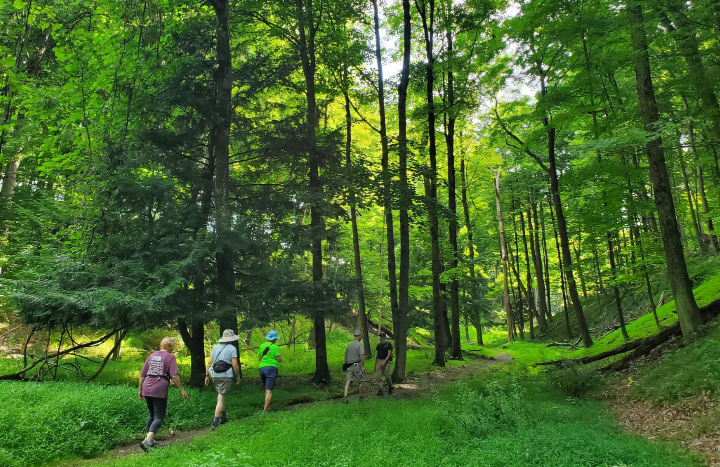
This series of interviews with members of the Cleveland Hiking Club, conducted in 2017, covers a number of topics relating to the history of the club, outdoor recreation and the natural environment, and members' recollections of hikes in the Cleveland Metroparks and Cuyahoga Valley National Park, as well as other parks and natural landscapes in Ohio, West Virginia, and Kentucky, and nationally and internationally. The Cleveland Hiking Club is one of the nation's oldest and largest organizations…