Dorothy Ipavec interview, 24 January 2017
Abstract
Dorothy Ipavec joined the Cleveland Hiking Club in 1948. She reflects on her experience of hikes and social events, as well as on early members of the club and how they influenced her interest in hiking and canoeing and knowledge of nature.
Metadata
Interview Transcript
Transcripts may contain errors.
Ruth Skuly [00:00:05] Yeah.
Dorothy Ipavec [00:00:05] Okay. You may have to talk a little louder because sometimes with these hearing aids, you never know. Okay.
Ruth Skuly [00:00:18] I think we're in good shape. I'm just going to ask you a couple of questions and you just— Go ahead and talk.
Dorothy Ipavec [00:00:27] Okay.
Ruth Skuly [00:00:29] I know you joined the hiking club in 1948, but did you hike before that?
Dorothy Ipavec [00:00:35] No.
Ruth Skuly [00:00:36] No. Well, what made you want to join the hiking club?
Dorothy Ipavec [00:00:39] Well, I've always liked to walk, and I don't know, I just— I saw an advertisement, a notice in the PD on a Sunday, and I thought, gee, that sounds like fun. And it was at the corner of Mayfield and, I don't know, I'm not sure of the cross street. But anyhow, so that was one I could get to easily, you know. And so I went out and I walked up to this one fellow and I said, are you leading the hike? He says, no, that fellow is. So I went over to him and I said, are you the leader? And he said, no, that fellow is. And I found out later that these three fellows, I mean, that's just the way they were, you know.
Ruth Skuly [00:01:22] Who were they?
Dorothy Ipavec [00:01:24] It was such a nice group. Then afterwards, they said, we're going to go down to Clark's to eat at 105th. Do you want to come with us? But I didn't go, because then I would have to get home after that. But it was such a fun group. It was just great. Then I just gradually kept going and going and got into it.
Ruth Skuly [00:01:50] Do you have any— Do you have any favorite hikes or favorite memories?
Dorothy Ipavec [00:01:55] My favorite winter hike is Stebbins Gulch. That was before the Arboretum took it over, so we could walk— I don't know who owned it then, but we could walk right down through the creek. It was beautiful. I loved that hike. Summer hikes, I never liked it when it was hot. I don't know, every one was different. One would be good because of the flowers and stuff like that, and then another one would just be the weather or something like that. But they were all different, and it was such a jolly group. We really had a good time.
Ruth Skuly [00:02:42] The club used to have as many social events as it did hikes, just about. You want to talk about that a little bit?
Dorothy Ipavec [00:02:51] Yeah, we had bowling. At that time, once in a while they would have an evening hike where we went to Lizzie's Brewery once, I remember. Then we would go to Cain Park, and we went to Chagrin Valley Little Theater. And Lakewood Little Theater and things like that. I think we had a swimming party once at— well, I can't think of it. The one down at Tudor Arms.
Ruth Skuly [00:03:24] Ah.
Dorothy Ipavec [00:03:27] Yeah. But other than that, it was mostly just Sunday hikes, and once in a while an evening hike.
Ruth Skuly [00:03:37] You did a lot of canoeing, too.
Dorothy Ipavec [00:03:39] Yes. That's when I learned how to paddle canoe. We went down to Portage Lakes. Then after that, a lot of times a group would— it wasn't a scheduled event, but a group would just get together. We went on canoe trips, and later on I remember a group, I think there were 4 or 6 of them, went down Grand Canyon. You know, hike down. But they were on their own. It wasn't a scheduled thing.
Ruth Skuly [00:04:10] Yeah.
Dorothy Ipavec [00:04:10] But it was always— it was nice when they got more evening hikes, you know. Usually it was a 10-mile morning and a 5-mile afternoon on a Sunday, and that was it. In fact, now they have more in one day than we had in a month. I can see why, with that many members. Wow, that's amazing. I can't imagine a hike with 40 people.
Ruth Skuly [00:04:40] Try 100.
Dorothy Ipavec [00:04:41] 100? Oh my gosh. Oh, wow.
Ruth Skuly [00:04:49] What about camp?
Dorothy Ipavec [00:04:51] Yeah, I like camp. I remember we planted those— are there still any of those evergreen trees in front of the cabin?
Ruth Skuly [00:04:59] Yes.
Dorothy Ipavec [00:05:00] Are there? Oh, good. I'm glad to hear that. Yeah, I remember planting those. We planted wall-to-floor roses along the parking lot, which were eventually all removed. I remember building— when they built the back porch and that extra room back there. At first, we didn't have water. Then Al Harper dug a well and put in a pump for us. I guess now they have water in the cabin, huh?
Ruth Skuly [00:05:35] Yeah.
Dorothy Ipavec [00:05:38] Yeah, good. Those camp events were really great, a lot of campfires. The group was so small that when we had Christmas banquets and stuff, we could have them at the camp, you know, a 40-mile hike banquet and stuff like that. But boy, many, many times I said how thankful I was to the people that bought that land. Boy, were they ever looking ahead. It was just great. Thank you.
Ruth Skuly [00:06:22] How did you get out to camp? How did you get out to camp in those days?
Dorothy Ipavec [00:06:26] At that time, a few people, not too many people drove. They would have a meeting place in town, like say, we'll meet at Brook Park and Broadview, and then somebody would make sure somebody with a car would come there and pick us up, and then we would go out. And so it worked out good. And of course, then everybody went on the same hike. I mean, if it was an east or west side hike, the same people, you know, where now they have to have— well, they couldn't all go on one hike.
Ruth Skuly [00:07:02] Right.
Dorothy Ipavec [00:07:03] They have to split it up. And at that time, you could get a bus out to Hinckley. I guess it was a Greyhound. But that didn't last long. They discontinued that. We spent a lot of time working at camp, putting in the parking lot. I remember when they put in the parking lot. It was great for overnights. You didn't have to come back into town. If they had something going on out there. I'm so glad they bought that land.
Ruth Skuly [00:08:03] I noticed in some of your earlier photos, some of the women were wearing skirts. Did they actually wear skirts on hikes?
Dorothy Ipavec [00:08:13] Yeah.
Ruth Skuly [00:08:14] What about shoes?
Dorothy Ipavec [00:08:16] Well, I had leather boots that I wore on a messy hike. Otherwise, you just wore regular shoes. It didn't, of course. All the warm clothing was a lot heavier than it is now. You know, they didn't have much down in that lightweight polyester stuff. Yeah, I remember I wore a long, like a trench coat the first hike I went on. You know, I mean, what else? That's what I had. And I remember I felt so conspicuous the first time I went downtown on a Sunday to go to a hike wearing slacks. Nobody wore slacks then. But it didn't take me long to get used to it. Shoes, I think shoes is the main improvement, you know, much lighter. [00:09:21] Lighter weight than heavy boots, leather boots.
Ruth Skuly [00:09:31] You were involved with the fight to save Whips Ledges. Do you want to talk about that?
Dorothy Ipavec [00:09:40] I don't remember too much about it, except I know we had a hike and tried to get publicity for that. The day of, on Sunday, when— I don't know, before they made decisions about it. I'm glad that the governor and the other people decided against it, because that would have really destroyed Hinckley.
Ruth Skuly [00:10:05] What were they going to do?
Dorothy Ipavec [00:10:06] Put a freeway through. That fell through, thank goodness. Just like Shaker Lakes, they stopped that one, thank goodness.
Ruth Skuly [00:10:22] Were you involved in that?
Dorothy Ipavec [00:10:23] No, I wasn't involved in that one. I guess we wrote letters to the governor and some other people, but other than that, I don't think we did too much except Except just try to talk about it and get people interested in saving the ledges. I don't remember very much about that, really.
Ruth Skuly [00:11:03] What changes between Besides the size and the number of hikes, have you noticed over the years?
Dorothy Ipavec [00:11:10] The biggest thing that amazes me are the trips. We went to New York and Pennsylvania, West Virginia, and I think in Michigan, yeah, and Ohio, of course. We never had any week-long trips. They were always just weekends. Usually to state parks, and quite often we prepared all our own food instead of eating at restaurants. I remember we had a trip to Allegheny for New Year's, and going into the park, the bus slid off the road. So everybody got out and pushed the bus, and we got it back on the road. But they were fun. I liked those. They had different accommodations. Some of them were rustic cabins. I don't think we had any where everybody camped out.
Ruth Skuly [00:12:20] No.
Dorothy Ipavec [00:12:20] There was always a building of some type. At Kelly's Island, we stayed in a barn. I remember the girls all on the top floor, the boys on the bottom floor, and everybody brought their own bedding and everything. They were fun. Then we had one up to Michigan. Helen Ballinger was in charge. She thought the more you bought, the cheaper it was. She had a whole case of toilet paper, and I don't know what else. Her brother had to rent a truck to get all this stuff up there. Then when the kids went to prepare one of the meals—
Ruth Skuly [00:13:11] The kids?
Dorothy Ipavec [00:13:12] They found she had bought about 20 pounds of frozen ground beef in one hunk, and it was still frozen. They chopped away, and we had dinner. It was fun. One thing, everybody usually was in a good humor about it. You could laugh about it. Although it was pretty— some of them weren't too happy. We did try to keep the price down so that anybody could go. I mean, it wasn't the price that held anybody back. If they didn't want to go, fine, but it wasn't because of the price. But boy, I'm just amazed with these trips now. Oh my gosh, Europe and Canada and— oh.
Ruth Skuly [00:14:04] That's great.
Dorothy Ipavec [00:14:08] Boy, that would be great.
Ruth Skuly [00:14:16] Some of your parties were pretty elaborate. In some of your pictures, I saw ladies in gowns.
Dorothy Ipavec [00:14:27] Yeah, like Christmas parties. party or the 40-mile banquet. Sometimes they dressed up for those, not when they were at camp, but there was a place on Euclid around 100th, Cirrhosis Club, was it, I think?
Ruth Skuly [00:14:46] Yeah.
Dorothy Ipavec [00:14:46] Cirrhosis, I'm not sure of the name. And we used to have— it was like a dance hall, and we had some pretty fancy parties there. It was fun making the decorations. I shocked a lot of people, I guess. One year when I was associate chairman, I scrubbed up some boots and put flowers in them and put them on the tables. I remember Rose Lassie said, I never thought Dorothy would put shoes on the table. But anyhow, it was fun. We made our own programs and usually our own entertainment, which was fun. It was such a diverse group of people, all different incomes, all different occupations. But you got to know everybody because it was only— if you're going to go hike today, everybody that wanted to hike was on that one hike. Of course, now you get to meet a lot of different people, more diverse. But it was really a good group. I really enjoyed it. That's when I got more— well, I always liked to be outside, but— You were always outside. I never paid much attention to wildflowers except violets. I learned a lot about wildflowers, trees, and things, especially from Mr. Bowser. He had a wonderful collection of slides, and he colored his— of course, then it was all black and white— and he colored his own slides. After he died, I tried to find them. But his son had the collection, and their basement had flooded, and they were all gone. But he had a beautiful collection of flowers, wildflowers.
Ruth Skuly [00:17:03] Bowser's name keeps coming up.
Dorothy Ipavec [00:17:05] Oh, yeah.
Ruth Skuly [00:17:06] None of us that are current members knew him. Knew him, no. If you could talk a little bit more about him.
Dorothy Ipavec [00:17:14] He was very interested in nature, and he would go around to schools and give lectures and show slides. He really was knowledgeable about that. On a hike, he was willing to talk and explain all these different flowers and what they were. Although they used to call him lugubrious Mr. Bowser. He had some odd habits, but he really was the one that got me interested in flowers and plants and things like that.
Ruth Skuly [00:18:06] He was pathfinding. Wasn't he Chief Pathfinder for a while?
Dorothy Ipavec [00:18:10] Yes, I think he was for a while. I don't remember exactly, but he did a lot of hiking. In fact, a group of us went with him out to Colorado. I think there were 7 of us went. He had odd habits, like he would He'd be driving along, and if he'd get sleepy, one girl was afraid he was going to fall asleep. He said, no, as soon as I hit the gravel, I wake up. It didn't bother him. It bothered her, but not him. He had some habits that people didn't really like, but he sure had a lot of knowledge. He did.
Ruth Skuly [00:19:04] We have the Goddard Shelter at camp, and none of us know who Charles Goddard was.
Dorothy Ipavec [00:19:12] Oh, boy. I didn't know him too well. He wasn't hiking very much when I joined. In fact, I don't even know what he did. I didn't really know him really well.
Ruth Skuly [00:19:39] The other name that stands out that we hear stories about, but none of us knew, was Dan Root.
Dorothy Ipavec [00:19:46] Oh, yeah. He's the one that got me interested in canoeing. And in fact, 4 different years I went on canoe trips with him up in Minnesota and Algonquin in Canada. He was quite an outdoorsman. He was a hunter, which I didn't approve of, but that's I need to hit another there. He was— I think he was from West Virginia, but he went to college in Minnesota, and that's when he got interested in the lakes up there. He would get maybe 8, 10 of us together, and we'd go up for a two-week canoe trip. That's when you really get to know people, when you're on your own and everything you need you take with you, or you do without. We had a lot of fun. He was— how should I say it?
Ruth Skuly [00:21:03] A loner?
Dorothy Ipavec [00:21:12] I don't know. I think he belonged to other outdoor groups. I'm not sure. I know he had a deerskin jacket that he had made, you know, tanned himself. And as far as hunting and stuff like that, I know one day, one year, he offered me a pheasant if I would cook it and he would come over for dinner. So I did. Now, that's the only time I've eaten pheasant. But he was— he lived by— I don't think he had an apartment. I think he lived with a family in a house. And he was another one that taught me a lot about Outdoor life and being out among animals and woods and stuff like that.
Ruth Skuly [00:22:37] Shorty Curlin is another name.
Dorothy Ipavec [00:22:41] Oh, my. He was funny. That's all I can say about Shorty. He and his wife had Pepperidge Kennels out in— not Bedford, Oakwood. He brought one of his dogs on the 40-mile hike, and the dog walked 40 miles with us. I never laughed so much as I did when Shorty was along. He was a real comedian. He was a bartender.
Ruth Skuly [00:23:31] Of course, there was Joe Mayer.
Dorothy Ipavec [00:23:40] Yeah. Joe was a good guy. He went with us on— I think he was on every canoe trip I went on. He was a hard worker. He did a lot of work at camp, and a good hiker. He had a very nice mother. We went to his house sometimes after hikes and things like that. He was a good guy. There was Addie Coverdale. She's another one of the older hikers. She wasn't doing too much hiking. She was very active, and she had good sense. She would think things out and make her decisions. She was a big asset to the club. Let's see.
Ruth Skuly [00:25:00] Bess Simpson?
Dorothy Ipavec [00:25:05] Yeah. Bess was a schoolteacher, and Bess had a mind of her own. She was— how shall I put it? She did what she wanted to do, let's put it that way.
Ruth Skuly [00:25:33] Okay.
Dorothy Ipavec [00:25:34] Nothing stopped her. If she wanted to go someplace, she went, and that was it. She was a canoe— she liked to canoe, too. In fact, she rode around with a canoe on her car sometimes. We had quite a few schoolteachers in the club, Addie and Bess. Who else was there?
Ruth Skuly [00:26:21] Justine.
Dorothy Ipavec [00:26:23] Justine, yeah. Mel, later on. There were a few more, I can't think of them offhand.
Ruth Skuly [00:26:42] You also had a bunch of marriages in the club.
Dorothy Ipavec [00:26:45] Yes.
Ruth Skuly [00:26:46] You ought to know about that pretty well, huh?
Dorothy Ipavec [00:26:49] Yeah, one year, 8 of us in the club got married, 4 couples. One of them just died in January, Ron Leach. He wasn't a member anymore, but he was the last one of the 8 of us to die.
Ruth Skuly [00:27:18] Yeah.
Dorothy Ipavec [00:27:18] Oh, yeah. It was— I think— then we had families come out to mark— well, just to come out. with their kids. And of course, Will Mondahn brought the kids out, and later on the Feelys. And it was a good group.
Ruth Skuly [00:27:51] Mm-hmm.
Dorothy Ipavec [00:27:51] Mm-hmm. One thing, we didn't have any really weird people in it, you know. I guess those people don't go for the outdoors. They were all different personalities, but we all seemed to get along pretty well.
Ruth Skuly [00:28:16] John Shade?
Dorothy Ipavec [00:28:18] Yeah, he was another one that had his own mind, so to speak, because we all do. One thing I remember, one hike on— when you mentioned John, I think it was down around Mohican, I'm not sure. Anyhow, we went on a Sunday hike, Sunday morning, and we came across all these nuts on the ground. They were shaped about like my thumb, you know, they were longer. And they were around. And he said it was a shellbark hickory. So we picked up a bunch of them, brought home, ate a lot of them, and we planted— Andy and I planted one in a milk— that time came in square cardboard cartons, remember those? A gallon of milk. So we planted one and set it out on the balcony of the apartment, and it grew in the spring. It grew up, and it's still growing in my backyard at home.
Ruth Skuly [00:29:20] Oh, wonderful.
Dorothy Ipavec [00:29:21] It's a beautiful tree. tree. The neighbors say, oh, what a beautiful tree it is. And it has never had any nuts because there were many others in the neighborhood, but it still is a gorgeous tree. This spring I had to have it trimmed because it was rubbing the houses, the roofs of the houses on both sides of me. I always think of John Shade because He told us what it was. I had never heard of it before. But my dad, when we took some back and showed them to him, and he said, boy, I haven't seen those since I was a kid. They were good, too, good to eat.
Ruth Skuly [00:30:07] Yeah. You met Mrs. McCarty?
Dorothy Ipavec [00:30:23] I met her once.
Ruth Skuly [00:30:25] Do you know there's a discrepancy about what she did for a living? Was she a truant officer? Do you know?
Dorothy Ipavec [00:30:35] I think so. I think I read that someplace.
Ruth Skuly [00:30:38] I think I read that also, but other people were I never heard that.
Dorothy Ipavec [00:30:47] She could have been, I don't know.
Ruth Skuly [00:30:49] Effie and Jay were both librarians.
Dorothy Ipavec [00:30:54] I had heard she was a truant officer. I remember she came out to a reunion once, and I met her. I never met Edna Kay Woolley. I think she had died by the time I got in the club. I give those early people a lot of credit for building the cabin and How do they fit all those people in the cabin?
Ruth Skuly [00:31:46] We don't. We have to put a limit on how many people can come.
Dorothy Ipavec [00:31:53] I know sometimes it would seem crowded with just what we had.
Ruth Skuly [00:32:00] Bought some covered canopies so that we can put tents out. Oh, that's a good idea.
Dorothy Ipavec [00:32:10] Yeah, I always liked events at camp. I remember when you and Mayers made apple butter one year. That was so good. I think camp had a lot to do with the club keeping together and getting going.
Ruth Skuly [00:32:50] Anything else that you can think of that you would like to add?
Dorothy Ipavec [00:33:06] We really enjoyed our weekend trips, so I could imagine how the group now enjoys those longer trips, because that's when you really get to know people.
Ruth Skuly [00:33:15] That's true.
Dorothy Ipavec [00:33:16] Rather than just walking with them for a while. I really liked those.
Ruth Skuly [00:33:32] You rented buses to take people to the weekend trips, or did you—
Dorothy Ipavec [00:33:37] I think Allegheny was the only time we rented a bus. Most of the time, we just pulled— they pulled cars. I didn't drive, but they would pull the cars and go. I think of going to Oglebay. We had these rustic cabins, and that was about it. They did have an inn then. Now when I see all these Christmas lights Swimming pools and all that stuff. I haven't been down there since all that's developed.
Ruth Skuly [00:34:25] I'm going to thank you, and I'm going to put this on pause. If you think of anything in the next few minutes, we can start it over again. Okay.
Dorothy Ipavec [00:34:34] Yeah.
Cleveland Hiking Club
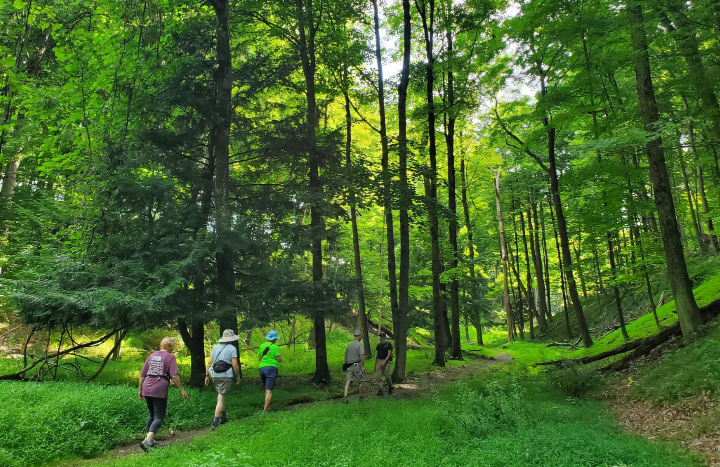
This series of interviews with members of the Cleveland Hiking Club, conducted in 2017, covers a number of topics relating to the history of the club, outdoor recreation and the natural environment, and members' recollections of hikes in the Cleveland Metroparks and Cuyahoga Valley National Park, as well as other parks and natural landscapes in Ohio, West Virginia, and Kentucky, and nationally and internationally. The Cleveland Hiking Club is one of the nation's oldest and largest organizations…