Jean and Paul Ruck interview, 24 April 2017
Abstract
Jean and Paul Ruck have been members of the Cleveland Hiking Club since the late 1980s. Most of the interview is devoted to memories of several hikes, including in Kentucky, West Virginia, Utah, New Zealand and Switzerland.
Metadata
Interview Transcript
Transcripts may contain errors.
Jean Ruck [00:00:26] All I can tell you is that I joined in— when did you say, '88?
Marianne Trausch [00:00:31] '87, I believe.
Jean Ruck [00:00:32] '87.
Marianne Trausch [00:00:33] Mm-hmm. Yeah.
Jean Ruck [00:00:34] '87, and the first hike I went on, I thought I was gonna die and never gonna do that again.
Marianne Trausch [00:00:40] Do you remember where it was?
Jean Ruck [00:00:42] Yeah, Bedford Reservation.
Marianne Trausch [00:00:44] Okay.
Jean Ruck [00:00:45] But then I don't know why I ever went back or why I ever hiked again.
Marianne Trausch [00:00:50] It was a tough hike, huh?
Jean Ruck [00:00:51] But I didn't tell him I was a member of the club at all.
Marianne Trausch [00:00:55] You didn't tell Paul?
Paul Ruck [00:00:56] No.
Marianne Trausch [00:00:56] Why not?
Jean Ruck [00:00:57] I didn't even know him then.
Marianne Trausch [00:00:59] Oh.
Jean Ruck [00:01:00] But we got married, he didn't know either.
Marianne Trausch [00:01:03] I see. Okay.
Jean Ruck [00:01:04] So yeah, so we got home from our, our wedding trip and I said, I got something I gotta tell you now.
Paul Ruck [00:01:15] Okay, Paul, you— We were at church. And she had said that she wanted to go on a hike. So we finished up at church, went out to the car, changed our clothes, and we went on a hike.
Marianne Trausch [00:01:29] Okay.
Paul Ruck [00:01:30] And we met a woman that just— we went to her funeral the other day, Eleanor Walker.
Marianne Trausch [00:01:37] Okay.
Paul Ruck [00:01:38] And she said to Jean, are you sure he can hike?
Marianne Trausch [00:01:45] And your response?
Jean Ruck [00:01:47] I said, I don't know, I never hiked with her before.
Paul Ruck [00:01:51] Okay.
Marianne Trausch [00:01:52] Do you remember where that hike was?
Paul Ruck [00:01:55] It was out off of Pleasant Valley Road. There was a trailhead out there, and we were hiking along out there.
Jean Ruck [00:02:04] And so Well, you went in there.
Paul Ruck [00:02:14] Yeah, we hiked there and we had no problem. Eleanor didn't question us anymore. Oh, very good.
Marianne Trausch [00:02:24] And you survived it, didn't you?
Paul Ruck [00:02:26] Oh, yeah.
Marianne Trausch [00:02:26] Good. So the rules were a little different back then.
Jean Ruck [00:02:31] Well, I found out that they just changed right at that time. Prior to that, everyone had to hike Was it five times or six times or whatever in a year before they could join? And they just changed it and said that spouses did not have to. So he joined right away.
Marianne Trausch [00:02:49] Okay. You got in the easy way.
Paul Ruck [00:02:52] Right. Slipped in, you know. Good.
Marianne Trausch [00:02:55] Okay, Paul, would you like to tell us a little bit about one of your favorite excursions?
Paul Ruck [00:03:01] Well, it was the 250-mile trip over a period of five years, so that'd be 50 miles a year. Every spring we went down to the Shell Toe, which is a big turtle in the Indian language. Because Daniel Boone had been inducted into the Indian tribe—
Jean Ruck [00:03:26] Shawnee.
Paul Ruck [00:03:28] So he adopted the name of Big Turtle. We created a patch that had the back of a turtle on it and then Shell Toe and what else. We issued that to the people that had taken the trip. What about the There was one particular hike that everybody remembers. It was called the Hike from Hell.
Marianne Trausch [00:04:02] I heard about it.
Paul Ruck [00:04:04] Okay, and it started out poorly because I stepped off the trail and into a patch of limbs, and one of them stabbed me in the back of the knee. But I had more nurses on that trip than you can shake a stick at. So they took care of the wound, bandaged it up, and off we went.
Marianne Trausch [00:04:27] Okay.
Paul Ruck [00:04:28] Then we found out the trouble we were in. There had been a snowstorm in late winter, early spring, and it had been a heavy snowfall that landed in these trees. It pulled the branches down and pulled trees down. It was that heavy a snowfall.
Marianne Trausch [00:04:47] Wow.
Paul Ruck [00:04:48] And so most of those trees fell across the trail. So we spent most of the time either dodging over limbs, under limbs, or around limbs to get down this trail. So naturally, what started off as, say, a 6-hour hike wound up to take until dark.
Marianne Trausch [00:05:08] Wow.
Jean Ruck [00:05:09] We couldn't go back because the bus had dropped us off at the beginning of the trail.
Marianne Trausch [00:05:14] Sure.
Jean Ruck [00:05:14] It was not going to pick us up until How many hours later at the end of the trail?
Paul Ruck [00:05:20] And we were very fortunate. He was a very sensitive person to other people's needs. He knew we weren't there, and finally one guy broke through and got to him and told him that it was going to be held up. And so he stayed at the end until we all got there.
Jean Ruck [00:05:41] After dark?
Paul Ruck [00:05:42] So that was about 8 o'clock at night, 8 to 9 o'clock at night we finished up, and it was supposed to start— end up before suppertime.
Marianne Trausch [00:05:52] Wow, he had some hungry people, I bet.
Paul Ruck [00:05:55] Well, plus worn-out people also.
Jean Ruck [00:05:57] Oh, I would imagine. That was minor.
Marianne Trausch [00:06:00] Yes, very good.
Paul Ruck [00:06:01] But the thing was, that was on a Tuesday. Now, Wednesday was our day off. On Thursday, everybody showed up for that next hike. There wasn't anybody that stayed home or said, I can't go.
Jean Ruck [00:06:21] I thought they'd all leave us. I thought they'd never stay with us.
Paul Ruck [00:06:25] That's the type of a group it is.
Marianne Trausch [00:06:28] Do you remember about how many people were on that particular hike?
Paul Ruck [00:06:32] It was probably about 20.
Jean Ruck [00:06:35] We only took 22, I think. Didn't allow any more than that.
Paul Ruck [00:06:41] Because we were limited by transportation. We had arranged for buses to take us to a trailhead and then to pick us up at the other end. We were lucky enough—
Jean Ruck [00:06:57] No cell phones either.
Marianne Trausch [00:06:58] That's right. You couldn't communicate.
Paul Ruck [00:07:01] We were lucky enough that we could arrange the transportation then. This company had 2 buses that they used. When they finished up with our group, they sold the buses. No.
Marianne Trausch [00:07:21] Does that say something about the group or the hygiene?
Paul Ruck [00:07:25] I'm not making any comments on that. That's for everybody else to deduce. Different people, you'll hear comments about you as you interview all these people, the ones that went the hike from hell. Oh yeah, I remember that. Yeah, yeah. And it is, it was a defining moment. Like I said, none of them quit. They all came back.
Marianne Trausch [00:07:47] Wonderful.
Jean Ruck [00:07:47] The next year. Yeah, you couldn't quit on the hike because it was only—
Marianne Trausch [00:07:51] You were there.
Jean Ruck [00:07:52] We were in the middle of a national forest.
Marianne Trausch [00:07:55] Sure.
Jean Ruck [00:07:55] And there was no access. So nobody could come get us.
Marianne Trausch [00:07:59] Sure.
Jean Ruck [00:08:00] We had to walk out of that no matter what. Wanda and I ended up the last ones. Did she tell you that?
Paul Ruck [00:08:06] Yes, she did.
Jean Ruck [00:08:07] I stayed with her, and she kept saying, Jean, don't leave me. And I'm not going to, Wanda. And she was so sure I was gonna leave her. I wouldn't leave you, Wanda.
Marianne Trausch [00:08:19] How did you advertise the trip? Back then, was it just in the news? We didn't have computers at that point.
Paul Ruck [00:08:28] Cecil Dobbins was the one that had started all these excursions. He had set up this communications through the paper. You had to have it, actually, a couple months in advance. You had to be able to tell them what you were going to do and how many people would be there. And then they could— the only ones that got to go were the ones that called in first.
Jean Ruck [00:08:54] Just like it is now. It's the same thing.
Paul Ruck [00:08:56] Okay, same thing.
Marianne Trausch [00:08:57] Okay.
Paul Ruck [00:08:57] Cecil had set the whole thing up, so any success in this club has to start with Cecil Dobbins.
Marianne Trausch [00:09:05] Okay.
Jean Ruck [00:09:05] Who did the first trips, right? And all we did was follow his— the method he used, put it in the News Steps, have people sign up, and then that was it. We did that for every trip, and so has everybody since, just about.
Paul Ruck [00:09:20] Okay. All right. That trip covered five years, from '96 to 2000. Then somebody said, what are we going to do next year? Because it was great. We got down into that country. Just as spring was breaking. The redbuds were out. Everything was blooming down in Tennessee and Kentucky that naturally were a few months ahead of us up here.
Marianne Trausch [00:09:54] Uh-huh.
Paul Ruck [00:09:55] So what are we going to do next year? So we figured, well, we couldn't stop just there, so then we went to North Bend, Kentucky.
Jean Ruck [00:10:10] Virginia.
Paul Ruck [00:10:11] Well, anyhow, North Bend Park in the next state over, I guess it was. That was that spring. It was the same type of a situation. In fact, probably some of the same people that were on the shelter were on that trip. The next year, we finished up down at the southern end of that state at Pipestem. Same type of a deal. It was for a week, and we just hiked the trails. Everybody seemed to enjoy it. Then we really couldn't continue. We didn't have anything else really planned. We let it go and somebody else's turn. Yeah, somebody else picked up the ball and scheduled a trip. But with Lynn, well, both Cecil and Lynn, most of their trips were away from the country. They did exceptional jobs because they hooked up Cecil had scouted out Switzerland pretty well, and we took a trip with him in '91. It was gorgeous.
Jean Ruck [00:11:43] This is what they gave us. Isn't it gorgeous?
Paul Ruck [00:11:48] That was after the end of the shelter week. Yeah, a beautiful Indian statue here. Look at—
Jean Ruck [00:11:56] now that they bought it.
Paul Ruck [00:11:57] See, there's a turtle on there.
Jean Ruck [00:11:59] There's our shell toe. Yes, how gorgeous. But that was a particular—
Paul Ruck [00:12:04] Alabaster.
Jean Ruck [00:12:05] It was not a cheap thing.
Marianne Trausch [00:12:07] No, very lovely. I guess everybody must have really enjoyed it.
Paul Ruck [00:12:12] Well, they seemed to, and so, yeah.
Marianne Trausch [00:12:15] Regardless of the hike from hell, everybody kept coming back.
Jean Ruck [00:12:19] Well, everybody talks about it.
Paul Ruck [00:12:22] They realized that they weren't going to get left. I think that was the main thing. We didn't leave until we had everybody out. I think we ate supper about 10 o'clock at night, something like that.
Jean Ruck [00:12:34] We were mad because— I was mad because we had been in touch with the Kentucky Forestry Division all the way through. They knew who we were, where we were going. We had asked questions. We had been in contact with them. Never once did they call us and let us know that the trees were all down on this trail and that we couldn't make it. They knew we were there.
Paul Ruck [00:13:04] So we went in that winter that they often raised all kinds of hell with the Ranger there.
Jean Ruck [00:13:10] We raised the devil.
Paul Ruck [00:13:14] He accepted it. They realized that they had Goofed completely.
Jean Ruck [00:13:20] What happened then, we did have to omit one day. We were not able to complete the whole thing, but we did do two more days of hiking on the Château.
Marianne Trausch [00:13:35] Okay, let's hear about your trip to Utah right after 9/11.
Paul Ruck [00:13:40] Well, we had scheduled this, naturally, well before That event. But when it happened, St. George, where the hike originated, was— there was a college, and they were concerned that we would be coming. So they called and wanted to know. So I told them, you don't know this club. I said, if the airlines are flying, we'll be there.
Jean Ruck [00:14:09] Nobody in the club called and asked us if we were going. Not a one.
Paul Ruck [00:14:14] Then the best part of it was there were even two couples that drove out and camped. They didn't go to the hotel where we stayed, they camped. They were there on time. It was a reunion of all the people. I'll have to say that that college really set the thing up well because they met Us at the planes. There were 3 different flights coming in. They met us, took us to where they had box lunches for us, and got us ready because it was going to be a little bit of a drive to go from St. George on up to where it actually started.
Jean Ruck [00:14:58] Las Vegas, we landed.
Paul Ruck [00:15:01] Yeah, we landed in Las Vegas.
Jean Ruck [00:15:03] Had to go to St. George.
Paul Ruck [00:15:07] It was well organized, and we were fed like crazy.
Jean Ruck [00:15:14] It was organized by Elder Hostel.
Paul Ruck [00:15:19] I think they were just relieved, the fact that they weren't going to get stuck with a lot of things they couldn't use. Many people have commented on that trip. It was one of the best trips I ever took. It started out when we got to St. George. We went up a hill, and some people said, we're going to die. It was—
Jean Ruck [00:15:49] Oh, the first day of hiking. High temperature.
Paul Ruck [00:15:52] It was all this mileage going straight up. I mean, you started off from zero and you went up. But again, once they had accomplished it, then the worst part of it was over.
Marianne Trausch [00:16:11] What were some of the other places you went besides St. George?
Paul Ruck [00:16:15] Well—
Jean Ruck [00:16:16] Oh, man, that's just where we started.
Paul Ruck [00:16:18] Yeah. What was the last thing we had?
Marianne Trausch [00:16:28] I think we were talking about some of the other places you went besides St. George.
Paul Ruck [00:16:33] Okay, well, that was the starting place. Then we went on up to Capitol Reef, which was fantastic because of the arrangement that had been made to purchase fruit that had been planted by the Mormons. Then from there, we went to Zion and—
Marianne Trausch [00:17:10] Bryce.
Jean Ruck [00:17:11] Bryce.
Paul Ruck [00:17:14] We had all different degrees of weather, though, and we stayed at Ruby's Inn. We came out one morning, and now this was warm weather, and especially out there, it was always warmer. But we got up one morning, and they had sprinklers on for the trees, and there was ice on the—
Jean Ruck [00:17:45] Everywhere.
Paul Ruck [00:17:46] The trees. Baba.
Jean Ruck [00:17:56] Yeah. Baba?
Paul Ruck [00:18:03] Maruna took the pictures. He's got pictures of those, all that ice. And then we- We just managed to hike every place we could. We had a forest ranger with us, and he took us to the spots that we weren't too sure of.
Jean Ruck [00:18:32] Mm-hmm.
Paul Ruck [00:18:32] All in all, I think that's why people enjoyed it so much, because it was so relaxed. The weather was warm. We were recovering from that national disaster, and so it was a good way to just come out of it. We just enjoyed ourselves and could forget about all the tragedy for a week.
Jean Ruck [00:18:55] Oh my.
Marianne Trausch [00:18:56] Oh, you had—
Jean Ruck [00:18:57] She hugged everybody. Everybody was sweetie.
Marianne Trausch [00:19:00] And this is Louise, Louise McDonough.
Jean Ruck [00:19:03] Yeah, everybody was sweetie. I was afraid to take Paul on the first hike. I said, now be careful, you don't know what's going to happen here. Sure enough, she comes down, oh, sweetie! And she grabs him.
Paul Ruck [00:19:17] So it can't all be bad, you know. No, I don't think so. Anyhow, then when we went down to Kentucky, Louise was adept at getting off the trail and coming back with unusual items. That's all. She came back once with a gun. Another time she came back with a bedpan. As we walked along, we came to one farmer's property there, and his whole driveway was aluminum cans that had been crushed and just paved his driveway with aluminum cans. She about went nuts because here were all these cans and she couldn't touch them. But the owner came out and turned around and says, hey, Ma, I think they're coming after my cans.
Jean Ruck [00:20:15] We went in that store and you didn't dare take anything because it was so dirty. Oh, the floor was all tobacco spit on it and I mean, it was— we thought we had time to stop and rest a little bit.
Marianne Trausch [00:20:36] Tell us about another memorable person.
Paul Ruck [00:20:39] Well, when we went to New Zealand, there was all kinds of scenery there. Gail Broughton was a member of the club, and she was also an artist. She spent quite a bit of her time recording the scenes in drawings and paintings. There are quite a few people who have some of her artwork. Yes, we do. The other thing on that trip was, We went to every local attraction we could. One of the members came and they suggested that you fly relaxed. He had this very plane hiking outfit on, and the problem was the airlines lost his luggage. So he was stuck hiking every day until they came up with some more clothes.
Marianne Trausch [00:21:58] Okay.
Paul Ruck [00:21:59] So we were going to go into this one museum, and the fellow that was leading it said, well, anybody that wants to go Come with me and we'll go in there and see what they have to show us. Jerry said, can I come? The leader turned around and looked at him and said, not if you're dressed like that. It was just typical of the fun, that's all. It was just one hilarious thing after another. The unfortunate part about that was that same fellow was leading the group There was a sidewalk, it looked like it went someplace. He walked off the end of it and fell about 5 feet. Oh, no.
Jean Ruck [00:22:41] That happened at home, didn't it? Or did it happen on the trip?
Paul Ruck [00:22:45] No. Anyhow, he wasn't hurt, but his dignity suffered, naturally.
Marianne Trausch [00:22:57] That was on the New Zealand trip as well?
Paul Ruck [00:22:59] On the New Zealand trip, yeah. We mentioned that Cecil Dobbins was probably the instigator of all these organized foreign trips.
Jean Ruck [00:23:11] Probably.
Paul Ruck [00:23:14] Probably because he had a business in Switzerland. He didn't proselytize the membership, but if you knew if you wanted to go on one of Cecil's trips, you just signed up. You knew all the particulars in advance, where you were going to go, how long you were going to stay, and what it was going to cost you. We were fortunate enough to go with him on a trip to—
Jean Ruck [00:23:40] Switzerland?
Paul Ruck [00:23:47] Yeah, it was Switzerland, but I'm trying to think. Wengen was one of the stops. Then the other place was a little village called Bettmeralp, and that was probably the most picturesque little place you ever wanted to stay.
Jean Ruck [00:24:04] Hmm.
Paul Ruck [00:24:04] There were no automobiles up there. You came up on a cable car and you walked, or they'd pick you up with a golf cart if you didn't want to walk. We were hikers, so it didn't bother us. You were met in the lobby of this bed and breakfast by a big Saint Bernard. He walked over and checked you out, then he went over and laid down. He was through with you. He knew you.
Jean Ruck [00:24:36] Uh-huh.
Paul Ruck [00:24:37] Bettemer Alp, to us, always when you mention Switzerland, it's Bettmeralp. Wengen was a commercial hotel. We went up the mountain and we were surprised at the number of Japanese tourists that were there. You could always tell because you had to have your luggage out by your door in the morning, and the Japanese all had these aluminum suitcases. All you looked down the hallway was all aluminum suitcases. We had a couple with us from Texas. Cecil always had to have a meeting the night before we took a hike. In Wengen, there was no spare dining room he could use, so they just told us, use the lobby. The lobby was all full of upholstered furniture. We always managed to find a place. What was his name?
Jean Ruck [00:25:50] Hmm?
Paul Ruck [00:25:50] I'm trying to think of the Texan's name. Anyhow, he and Cecil had a longtime relationship, and he had been hurt in an accident, and Cecil didn't think he was coming on the trip. But he came. When we were down in the lobby waiting, he came down the steps. There was one place left to sit, and it was next to Cecil. Cecil looked at him and said, well, it looks like you're going to have to sit over here next to me. Without missing a beat, he turned to Cecil and said, now don't you touch me!
Marianne Trausch [00:26:34] Okay, in wrapping up this interview today, I'd just like to ask you, you know, what has the hiking club meant to you over these many years?
Jean Ruck [00:26:47] It's been an opportunity to contact people with like thoughts, that thought as much of the outdoors as I did, and also something about That characteristic means that they're not put on at all. They're not false. They're real people. And there's no point in trying to be something you're not, and nobody does. They've been real genuine people, and I've enjoyed them.
Marianne Trausch [00:27:23] How about you, Paul?
Paul Ruck [00:27:24] Well, it's been a time for Friendship and enjoyment of people along with the physical activity. We've always had a good time with all of these people. As Jean said, they were just people. They weren't putting on a front. That's the best part of it. You always knew you were going to have a good time when you went out with the hiking club.
Marianne Trausch [00:27:54] Wonderful. Well, I really appreciate both of you taking the time today to share your memories about this club that has meant so much to you. Thank you so much.
Jean Ruck [00:28:06] Thank you.
Paul Ruck [00:28:07] You're welcome.
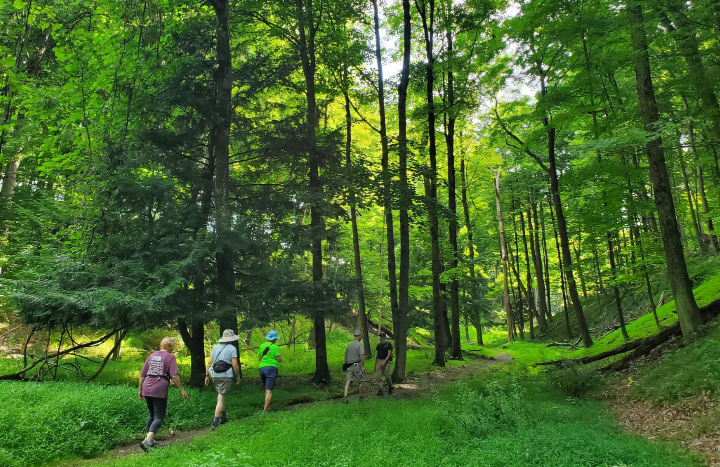
Cleveland Hiking Club
This series of interviews with members of the Cleveland Hiking Club, conducted in 2017, covers a number of topics relating to the history of the club, outdoor recreation and the natural environment, and members' recollections of hikes in the Cleveland Metroparks and Cuyahoga Valley National Park, as well as other parks and natural landscapes in Ohio, West Virginia, and Kentucky, and nationally and internationally. The Cleveland Hiking Club is one of the nation's oldest and largest organizations…