Brent Larkin interview, 02 June 2017
Abstract
Brent Larkin is the retired director of the Cleveland Plain Dealer editorial page. His career as a journalist covering Cleveland politics began in 1971. This 2017 interview was collected as part of a yearlong, community-wide commemoration of the 50th anniversary of Carl Stokes' election as mayor of Cleveland.
Metadata
Interview Transcript
Transcripts may contain errors.
Brent Larkin [00:00:51] Well, when I started out of college, I was a child and I had been away for four and a half years at college. So I don't pretend to suggest that I was paying a lot of attention to what Carl Stokes was doing as mayor, what Jim Stanton. But over a fairly short period of time, I picked up on it. And 1970 in Cleveland was a period where we were, the city was at the in still an ongoing, there was a transition. You know, when Carl Stokes ran for mayor in 1965, he almost won. And he ran again two years later and he won. And that broke a lot of ground in terms of racial inclusivity. And he was a trailblazer. And it caused a lot of political unrest. And when I began covering city hall as a 22 year old, 23 year old in the summer of 1971, Carl was still mayor and there was a lot of political conflict with the city council. There were 33 councilmen at the time. There were almost more than three quarters of a million people lived in the city itself. When I started covering city hall in 1971, Cleveland was a very different place. It still, downtown was starting to age a lot, but there were still probably three times as many big companies housed in downtown as there are today. It was a very different city.
Dee Perry [00:02:46] Carl Stokes was still mayor, as you mentioned. How did you see the Cleveland Press covering the final year of his administration? What was the attitude towards what he had done, what he was doing?
Brent Larkin [00:03:00] Well, that's a great question because it's another example. Cleveland in 1971. Carl Stokes was in his last months in office when I, when they, when they tossed me into the pond of city Hall. But it was a two newspaper town and that is. And newspapers were still thriving. And there was this really cutthroat competition between the Cleveland Press, which was the afternoon newspaper, and the Plain Dealer, which was the morning paper. And in the '60s, the Cleveland Press had been named by Time magazine repeatedly as one of the nation's 10 greatest newspapers. But afternoon newspapers for economic and social reasons were in decline. But it was so there was much. There was an edge to the coverage and competition is a good thing for journalism. And. And so every move that Carl Stokes made or Jim Stanton made as council president received a lot more scrutiny than perhaps mayors receive today in Cleveland or Frank Jackson receives today.
Dee Perry [00:04:15] So was the paper criticizing what he was doing, what Carl Stokes was doing and mayor?
Brent Larkin [00:04:26] The press's attitude towards Carl in his final year or so as mayor was more of a neutral thing. It was. The Plain Dealers was Plain Dealer had endorsed Carl in 1967. And that was a significant thing for the Plain Dealer to do. I didn't work at the plane. I was in college in '67. But then the Plain Dealer fell out with Carl and became one of his. A significant critic of the Stokes administration and Carroll and the publisher of the Plain Dealer. A good relationship turned sour. And so there was not all was well between the media establishment and Carl had a' This is an example of how much different it was in 1971. Carl had a weekly news conference that was televised live every, I believe it was, Friday on Channel 3. I mean that's just unheard of today. We're doing this in 2017. The mere thought that Frank Jackson might have a news conference that would be televised. No one would watch it. Well, people. Cleveland had a middle class in 2000, in 1971. And people were. They cared about government, they cared about politics. And it just goes back to the point about Cleveland being very different today. Am I talking too long?
Dee Perry [00:06:08] No, sorry. That was my reaction.
Brent Larkin [00:06:11] Okay.
Dee Perry [00:06:14] What was? What was the real? How soon did. Did the papers know that Carl wasn't going to run for a third term?
Brent Larkin [00:06:27] I believe Carl announced that in early 1971. It was a surprise. I was. I was not covering city. He had already announced that when I got the thrown into the pond in July of '71. He made the announcement after he called a bunch of friends to his house, I believe and over dinner told them he had decided not to run. Which it was a bombshell. But he was going to. Cleveland elected its mayors back then every two years. Now we elect them every four years. And it's tough. You know, you're always running for reelection. And it's far from a certainty that Carl would have run won a third term had he chose to, you know, to run in 1971. But he had quietly negotiated something with NBC News in New York and he decided to leave town and he did.
Dee Perry [00:07:38] I'm curious because the tenure of Carl Stokes as mayor overlaps the beginnings of Louis Stokes career as congressman. How frequently and in what contexts did you write about Louis Stokes during those early years?
Brent Larkin [00:07:56] Almost none at all until sometime in. After the mayoral election in 1971, which Carl, even though he wasn't on the ballot, was very involved in. And we can talk, I mean extremely involved in. I know from paying attention to things that Lou Stokes was not overly involved in Carls's 1960 and then his historic win in 1967, his mayoral elections. But Lou came. Lou was in Congress. He was elected to Congress because Carl was involved in creating a majority minority district. He cut a deal with Jim Rhodes in 1967 or 1968. Jim Rhodes was governor at the time. Lou didn't. Lou wasn't a major player yet. He was a new congressman, didn't especially covet a career in elected life. And it just kind of fell into Place in 1968. And so he was not a player yet. He was going to become a player, but he was not a player in the early days of the 1970s.
Dee Perry [00:09:15] I want to go back to what you were just talking about in terms of Carl Stokes being involved in the 1971 election.
Brent Larkin [00:09:24] Oh, okay. I'm going to try and be concise. In '71, Carl decides not to run his primary. One of his closest friends and allies was Arnold Pinckney. Worked with him, was at the time, I believe, president of the Cleveland Board of Education. Arnold wanted to run for mayor. Cleveland elected its mayors back then in partisan Republican and Democratic primaries. The way we elect presidents, the way we elect our governors, not the way we elect mayors today. That was changed in the early '80s. So Arnold decided to run as an independent so he didn't have to run in the Democratic primary and perhaps lose. Republican candidate was Ralph Perk, county auditor, Eastern European, big in the significant base in the nationalities movement. Lived on East 49th street in a tiny little shack overlooking Jones and Laughlin Steel. So Jim Carney, millionaire developer from Fairview park, moved into Cleveland to run for mayor as a Democrat. And he ran against Tony Garofoli, who at the time was council president. Carl disliked Tony Garofoli. So he endorsed Carney in the Democratic Party primary. And Carney upset Garofoli won the primary. So then Carl, after having telling his constituency, his base, which is largely the African American community, you have to vote for Carney in the primary. And they did. Now the elections, the general elections, five weeks later. Carl then went back to his same base and said, forget what I told you about Jim Carney. Now you have to abandon Carney and vote for Pinckney. And that's a complicated message for anyone to absorb. What do you mean you just told us to vote for Carney? Well, Carl tried it, and it didn't work. So Carney and Pinkney split the Democratic vote down the middle. And right between them walked Ralph Perk, a Republican. Not many Republicans in Cleveland, more than there are today, but still not many. And Ralph Perk walked between them and was elected mayor. So in retrospect, a lot of people blamed Carl's strategy for contributing to what happened. And I think that criticism was fair, wasn't Carl's intent, but it didn't work out the way he wanted it to.
Dee Perry [00:12:24] That said, you were covering city hall at park politics for the press when Ralph Perk was in office. How did Perk deal with the initiatives that Stokes had set into motion?
Brent Larkin [00:12:43] Not well. Through Carlos. The second term, Carl's second term as mayor, the city began to experience some financial difficulties. They tried one tax increase. It was not approved. So Perk became mayor in part on a no new taxes platform. And Ralph was mayor for three terms. He beat in 1973, he beat Kearney, kind of.That was complicated. But then in '75, he beat Pinckney. These are Arnold Pinckney, the school board president. And Ralph never increased taxes. And by the time he was removed from office in the mayoral election of '77, the city the stage for default. The table was set for the city's default. I'm getting ahead of myself. But Perk ignored much of the things. And Kyle's legacy was a mixed bag because political. There was so much political conflict with council. Carl walked out of city council and never to return to the council meetings, which is a tradition. In early 71, things got so bad that Carl took his entire cabinet out of council and never came back. So it was a tough time politically. And, you know, Carl is a historic figure, but it was tough to get much done back then.
Dee Perry [00:14:23] Some of the things that he set in motion, the equal opportunity employment, Cleveland now.
Brent Larkin [00:14:33] And he had. He put in place some programs that, you know, he opened the doors, he opened hiring opportunities to people who didn't have those opportunities in the past. He was involved in urban renewal and drug some job creation stuff on the east side in the city's poorer neighborhoods. He had a program called Cleveland now, which ended up as an extraordinarily controversial thing because money got into the wrong hands, and it got into the hands of people who were later involved in criminal activity. It was a tough time to be mayor and, you know, he made a lot of history, but it was tough to get a lot done.
Dee Perry [00:15:27] What sort of impact did you see Louis Stokes having on the city of Cleveland as he continued his tenure in Congress? Actually, I should back up and say, when did you first start recognizing the journalists, start recognizing Lou as a power, as having a power base?
Brent Larkin [00:15:49] Excuse me. Lou's stature as a politician began to grow after Carroll left town after the 1971 mayoral election. The Democratic party was in the throes of a leadership problem because the city had just elected a Republican mayor, and there's, in a city that was overwhelmingly Democrat. So they decided to have, to create what was called a troika, where you would have three party co-chairmen, and it consisted of Tony Garofoli, a name I mentioned before, and Hugh Corrigan, who was a county commissioner, and Lou Stokes. So suddenly Lou Stokes became a co chairman of the county Democratic Party. First minority to have a voice in the party. It's a big deal, real big deal. And Lou tended to get along. Lou was a very easy guy to get along with. And he developed a relationship with these other co chairmen and the party started to begin, you know, walking into the 20th century, which in some things it was not very open minded about then. Lou Gott was also at the same time gaining stature in Washington. So he didn't stay very long as chairman. He passed the baton to George Forbes. But after Kyle left is the short answer. Lou became to be started to become a player in city politics because there was a void. Carl's loss created a void, let's face it.
Dee Perry [00:17:40] And he also, as early in his tenure as a congressman, got onto the House Appropriations Committee, which to him was the most important committee of all, I think, I think he said something like, all the others are window dressed.
Brent Larkin [00:17:58] Well, and he was on Appropriations and he became a. Which is the most important committee, and he stayed on Appropriations and he became, eventually became what they call a cardinal. And Cardinals are this very select group of people with a lot of seniority and a lot of committee clout who essentially and historically have run the Congress when things were changing dramatically 30 years later. And that's in part is why Lou left Congress. He was frustrated with the animosity, which was starting to be, you know, it's worse today in 2017. But it was bad when Lou left, which was now when in 1998 or 2000. But Lou was beginning to accumulate power, which he used for Cleveland and Greater Cleveland's benefit in later years when he became a cardinal.
Dee Perry [00:18:59] Can you talk about some of the details of how he used that power to benefit?
Brent Larkin [00:19:05] Well, this was another. Again, it's a days gone by where earmarks were very important, very important part of the federal budget and spending where you could target programs, target designed specifically to, you know, for Tri-C in Parma, in downtown campus, or you could target programs to rebuild the Tower City area behind the terminal tower. And now earmarks are gone as of this, as of when we're sitting here this morning. But earmarks are really important. And Lou was great at getting money for worthwhile projects in Cleveland having to do with health care and housing. You know, Lou is a prod. Lou lived. He was not exactly a product of the projects, but he lived in the projects for a time in his life and for downtown development. And Lou's focus on those things paid off for Greater Cleveland.
Dee Perry [00:20:12] A little while ago, you were talking about what a nice, easy guy Lou was to work with. I wanted to have you talk a bit about the contrast in styles between Carl Stokes as a political leader and Louis Stokes as a political leader.
Brent Larkin [00:20:31] Well, if we're going to talk about them as a political leader, you also have to. I'm going to have to talk about a little bit about their. Their personal styles and their personalities. And first of all, it's important to note they were extraordinarily close. And Lou in, you know, Carl died in the mid-'90s and Lou lived a long time, quarter century after that. And no one was a fiercer defender of his brother's legacy than Lou Stokes. And so they were really close. And Carl was the younger brother, but they could not have been more different. Lou was just, no, not almost every sense of the word. He was, in every sense of the word, a consummate gentleman. He was actually a pretty gentle man until you crossed him on something that he believed in. And he was widely. He was adored, admired, respected. Carl was more complicated. Carl was the most charismatic and complicated politician that I ever covered. And he was very different. But he was very charismatic and he knew it and he used it, wasn't afraid to use it. He was also more political than Lew. But together they formed, these two brothers formed what was probably the most powerful political entity in the United States of America in the 70s and into 80s and into the 90s. It still exists today, but it was called the 21st District Congressional Caucus. Carl started it. Lou built on that success. And I'm kind of straying a little bit on their personalities, but That's a big part of their legacy.
Dee Perry [00:22:53] Actually, I wanted to talk about a piece of that. That power base of Lou Stokes, because I saw something recently that I don't think I knew before. But at the 1992 Democratic convention, his name was in contention for the presidential nomination. Was that a serious run or was that just a?
Brent Larkin [00:23:18] No, I don't think there was a year in there, and I met. When Shirley Chisholm ran for president, you might recall, and. But it was around that time. No, I don't think Lou was ever a serious. I mean, Jesse Jackson was a trailblazer in terms of African American running for president. And Jesse ran in 1984 and again in 1988, and there's all kinds of Cleveland connections there. And Arnold Pinckney ran his campaign for president. Another guy from Ohio ran his camp. Jackson's second campaign for president. I don't remember Lou's name ever surfacing in a serious way. And Carroll was a judge by then.
Dee Perry [00:24:19] We were talking about how Congress was changing in the 1990s. At a point in 1994, Lou was talking about his time in the House maybe ending. What was the political landscape at that time?
Brent Larkin [00:24:36] Bill Clinton was president, but in 1994, the house changed hands, the Democrats lost control. And the Gingrich revolution, you know, this. The Contract for America is what he called it. Newt Gingrich became Speaker of the House, very conservative Republican. And Lew would later say that it was 1994 that caused him to question how long he would want to stay in Congress. And. And all of a sudden he became a member of the minority party. You lose a little bit of your clout no matter how much service you have. And so eventually, a couple election cycles later, he left. But 1994 was the significant moment that caused Lew to begin reassessing. He had just lost his brother, and so it was a tough time.
Dee Perry [00:25:43] You've mentioned legacy a couple of times in terms of Carl and Lou, and I wanted to have you expand on that. What do you see as the lasting accomplishments, things that we can look at today and say that wouldn't have existed if Carl hadn't been here or if Lou Stokes hadn't been here?
Brent Larkin [00:26:03] That's a really good question. And once again, with Carl, it's more complicated. Hey, look, Carl Stokes opened the door to Black voters here. And this was a big deal nationally. I mean, Carl Stokes, you know, drawing of Carl, photo of Carl Stokes, he was a Time magazine cover story after his election. Was he? Carl was talked about really seriously in 1968. As a potential running mate with Hubert Humphrey when Humphrey ran for president. That's Carl's legacy. And it's not really gets back. You know, it was tough to get things done as mayor. The city didn't have any money. City was changing too fast, and it created a lot of political. Carl's legacy is in the doors that he opened for, for kids. You know, I remember in Cleveland, you used to see photographs on the wall and you go into Black households in the '60s and early '70s, and you'd see a picture of JFK, Martin Luther King Jr. And Carl Stokes. You would see that everywhere. That's Carl's legacy. And Lou's legacy is actually pretty different. He continued to stand for the same things that Carol did, but he did a lot in terms of programs that I talked about involving housing, health care and poverty. You know, Lou cared about those things and he was able to accomplish a great deal in terms of trying to bring money to anti poverty programs, not only in Cleveland, but everywhere. If you. You heard a lot of these stories at Lou's funeral, you know, a couple years ago about all the work and how much success he had in working on those things. So their legacies are actually pretty different.
Dee Perry [00:28:16] Thinking about, though, the things that they accomplished and not having background of wealth and privilege to push them forward, I'm wondering what advice you have for younger generations, younger generations to prepare themselves to walk that path of service and leadership.
Brent Larkin [00:28:38] I don't think we. I don't think there's enough role models actually in politics today. And maybe that's part of the problem. The. I know I run the risk of being accused of being old when I talk about this, but the quality of public servants In Cleveland today, that is Cleveland City Council compared to 45, 50 years ago, there is, you know, Cleveland had more people, had a more vibrant middle class, and it's tougher today. And the advice you, you know, there are some role models you can look up to to pay attention to how they did it. And frankly, of all the people we've talked about this morning, none are better than Lou Stokes, because Lou Stokes was a great role model for young people, or he should be because he led a life that was pretty exemplary in almost in every way imaginable.
Unidentified speakers [00:29:46] [crosstalk] I am rolling.
Christine Hickey [00:29:54] Okay. So Dee, whenever you're ready for me, start back up again.
Dee Perry [00:29:57] Okay. Brent, I wanted to ask about the Congressional Black Caucus. That was. Well, explain what it was and why it was important.
Brent Larkin [00:30:12] The 21st District Congressional Caucus, which was formed by Carl, but Lew made it into arguably one of the most powerful political entities in the United States. And they did it by. I cannot overstate the power that this had in electing a litany of candidates from the bottom of the ballot to, you know, a council person or to judges, to Congress, members of Congress, to mayors, to councilmen. And they built this into a force where you almost had a- They were able to produce almost a monolithic Black vote in any given election. And Carl at first, but then Lou really made this into an art form. They were not above using the caucus as a weapon to punish Democrats or Republicans, but Democrats who they did not view as being in line with their views on civil rights or other issues relating to Black Clevelanders. So they weaponized it, and they did it with enormous success. If I was a candidate for, let's say, judge in. In the '70s and '80s and '90s in Cuyahoga County, and I had a choice between the endorsement of Lou Stokes caucus or the Democratic Party, without even thinking, I would choose Lou Stokes in the 21st District caucus. That's how much clout they had. And look, they punished some Democrats. That's not to say they were always right or that I agreed with them or. But, boy, you don't sell them short in terms of influence. It was probably the most powerful political. I've been doing this for, gosh, almost a half a century, and no entity ever had as much power as that caucus. I think it's waned a little bit now because of population. Cuyahoga county has experienced an enormous amount of flight, white and Black. And city of Cleveland, as we all know, is half as big as it used to be in terms of residents. So it's not as powerful. But. Stephanie Tubbs Jones, after Lou and then Marcia Fudge today, it's still a force to be reckoned with. Maybe not as much so as 20, 30, 40 years ago, but, you know, don't cross the caucus.
Speaker C [00:33:06] Can you tell us why the Black Caucus was? Mention the fact that you mentioned it was his legacy and why. Why it was? The caucus was building the caucus into such a mighty political force?
Brent Larkin [00:33:15] It was Lou's legacy, Lou Stokes' legacy, because they were able to open political doors. The caucus was that in the past had been shut to minorities and they elected Black women to office. And that happened a little bit in the past with people like Jean Capers and others, but they just changed the nature of politics in greater Cleveland, and for the most part, for the better. And when you can do that, you know that's quite an accomplishment. And that's worth- That's the definition of a legacy.
Dee Perry [00:34:11] And how was it as the caucus as a training ground for pulling in young would be politicians?
Brent Larkin [00:34:21] Well, it was this octopus you had on Labor Day and you still had in Labor Day. You know, they would have this parade and a picnic out in Woodland Hills and presidents would come and presidential candidates would come. If you are a Democrat and you're running for president or if you are president, you know, that is Bill Clinton being the perfect example. You would never miss that Labor Day event. It was a sight to behold. The influence and at the core of that is Carl in founding it and Lou in creating. In building it into a fearsome political machine. You know, mild mannered Lou. Everybody loves Lou and Lou because Lou was a really sweet man, don't get me wrong. But there wasn't anything sweet about the caucus. It was a forced force of nature. That work?
Christine Hickey [00:35:37] Yeah, I think so. [crosstalk] Make sure you look at Dee when you answer, even if I ask you a question.
Brent Larkin [00:35:42] Oh, you mean like- [crosstalk] Carl we were going to talk about. Carl's- Yeah. Okay. Carl's return.
Dee Perry [00:35:58] You had a connection with Carl Stokes such that when he decided to return to Cleveland, you were somehow.
Brent Larkin [00:36:08] Carl did pretty well in New York. He was- I think he won a local Emmy and the local news cares a lot about Emmys. And he was. I think he started as a weekend anchor and he became a reporter and he was still there in the Democratic national convention in 1980 was a significant convention in terms of. It was when Kennedy tried to take the nomination away from a sitting president when Ted Kennedy ran against Jimmy Carter. So the Republican. I mean the Ohio delegation was housed in the. The Sheraton Hotel on 7th Avenue. And. And I was there. I was at. Went to way too many conventions. And one of the first or second day of the convention, I'm sitting in the lobby and in strolls Carl. And he wasn't a delegate, he wasn't covering it. And he came up and he sit down next to me and he said, Larkin, where's Feagler? I need Feagler. And he's talking about the legendary Dick Feagler, the columnist mostly for the press and then later for the Plain Dealer. I need you to find him for me. Okay. I guess I can follow orders. So I found Feagler. And that night Feagler went over to Carl's apartment, which was somewhere in Manhattan. And Feagler came back with a story that Carl Stokes was coming home to Cleveland. Now the next morning's Cleveland Press you had this historical challenge to the Jimmy Carter's presidency from Ted Kennedy. The screaming headlines in the press was, carl Stokes tells press he's coming home. Or something like that. So Carl came back and, you know, it's tough to come home again. And it was. He came back to a Cleveland in 19. He probably came back in late '80 or '81, and he came back to a Cleveland. The demographics had changed, the leadership had changed. George Forbes was the king of the Hill then in local stuff. And so you had Lew as a powerful congressman. You had George Forbes as the most powerful council president in the city's history. And, you know, he still holds that title today. And then you had Arnold Pinckney, who was still a someone, a significant player. Well, and Carl came back and, you know, he wasn't going to get the title back, so to speak, but he became a judge. And Carl was a smart guy and he was, you know, he still hadn't lost his charisma, but he didn't become, you know, the. He wasn't the leader in the Black political community. And that caused some problems. He had some. He had a brief falling out with his brother, which didn't, you know, that rarely happened. And it got healed, it got fixed. But he had a significant falling out with people like Pinkney and Forbes, and that later got fixed, but it wasn't the best of time. And then he had some incidents that he was involved with that, you know, he turned on the media, he turned on me, turned on a lot of people.
Dee Perry [00:39:48] Did you get the sense that he wanted that power back, that he wanted to be?
Brent Larkin [00:39:53] Well, you know, Carl had a sizable ego. You know, he was handsome and smart and. Yeah. Yes, you don't want to come back. And he was appointed and then elected as a municipal court judge. But I think his. I don't know exactly what his aspirations were. And then in the early '90s, he got sick, and I'll never forget he would go to the Clinic for treatment, and I would meet him at furlough. We were friends again now by then at the. What's the name of the fancy. The hotel there next, adjacent to the Clinic. That's still there. Yeah, the Intercontinental. We would meet for lunch at the Intercontinental. And he was, you know, he was. Carl was ill and- And. But he had been- He was ill. And that dragged on for a while, and then he passed away, you know, far too young an age. And. But it was never the same. You know, Thomas Wolfe was right in that aspect. You can't come home. It was not always the most pleasant time for Carl. But Lou never left. Never, never ever. And Carl's funeral, which was, which was a kind of a magnificent event, if any funeral could be made. It was something that, you know, that was another. It was almost a historical event. It was a music hall, I think. And Mike White was mayor and, you know, they. It was. He got the send off that he deserved. You know, there's only one. You can only. Only room for one first. And Carl was the first. And Mike White and Frank Jackson would not. Would not be mayor today had not he been the first one to open that door. We. Okay, what'd we miss?
Christine Hickey [00:42:04] Do you have- Is there anything, you know, we've been talking a little while now, and I didn't know if anything, you know, through this process has come to your mind that you would want to say?
Brent Larkin [00:42:13] Well, the stuff about Carl we get, we hit and the caucus stuff is significant. I don't know, Louis. In retirement, Lou continued to be, you know, Lou's retirement went a lot smoother than Carl's, you know, I guess. [crosstalk] We have a little time. Yeah.
Christine Hickey [00:42:38] So I just didn't know if there was anything else that you wanted to make sure we heard.
Brent Larkin [00:42:43] No. I mean, no. Unless you want to talk about Lou. He didn't entirely recede from the political scene, but he was fairly gracious in terms of acknowledging that Stephanie was. Now had his job in a way.
Christine Hickey [00:42:59] Do you feel he- In a way, he worked on his succession. Was there some succession planning in a way, or how was that? I know, not official or anything, but was he.
Brent Larkin [00:43:13] I believe I can talk about post Congress if you want. I mean, go ahead. I interrupted. Pardon me.
Christine Hickey [00:43:22] Do you think he was seen as a mentor to some of our, you know, the younger generation coming up when he was in office?
Brent Larkin [00:43:30] I think Lou was a bit of a mentor to Stephanie probably. And Stephanie was a Black woman who started it, Stephanie Tubbs Jones, as a muny court judge and then a common pleas court judge in 1984. Don't hold me that year, but I'm pretty sure I'm right. She ran for the Ohio Supreme Court and almost won. Come on. A Black woman ran for- against- Craig Wright was who she ran against, and he was a justice and she almost beat him. And so then- And then she became county prosecutor. So she was perfectly positioned to become. To be Lou's successor. And Lou never discouraged her along the way. And when Lou decided not to run, there was a bit of a competition, but it was really never a competition. And Lou, he really did take some considerable Pains not to get in her way. He was really, you know, God, we're making Lou into a saint. But he, again, he was really good about that. Got out of the way, still remained involved, got involved, made some money, went to Squire Sanders, was on the board of Forest City. You know, he lived this really good life. He, you know, he had kids who adored him and grandchildren. And he lived a long life. And in- When was it? In July of '15. I remember where I was. I was at Starbucks reading at night. The phone rings, and it's Lou. And he said to me, I had been retired a long time then. Brent, I have something I want to tell you. I'm sick. I knew this, but I pretended that it was news. I'm ill, and I would like for you to write my obit. And this was a Saturday night. And I said, Lou, I will call the people who run the Plain Dealer tomorrow morning. And. And I don't think that will be a problem because I was not an employee of the Plain Dealer, and it wasn't a problem. And then over the next. I think he lived about six or seven weeks after that. I talked to him all the time on the phone, and I spent a couple hours with him. And so I was able to- I was actually quite flattered that he asked me to write his obit, which I did. And, you know, he passed away. But he lived a long life, and they don't get much more meaningful than the life he led.
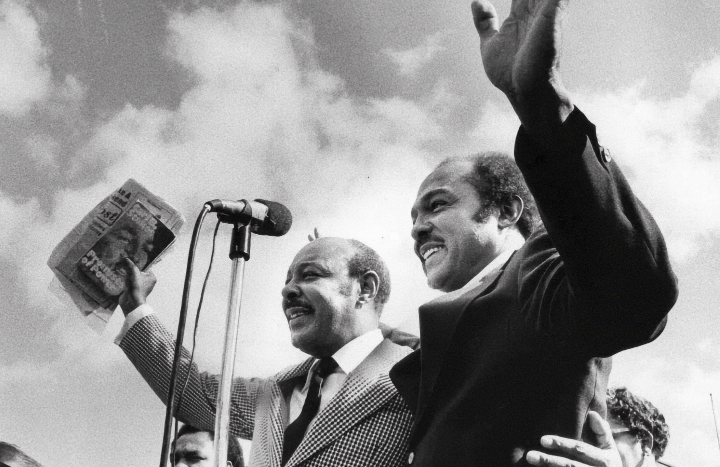
Stokes: Honoring the Past, Inspiring the Future
This collection of interviews was conducted by staff at Cuyahoga Community College's Jack, Joseph and Morton Mandel Humanities Center as part of a yearlong, community-wide commemoration of the 50th anniversary of Carl Stokes' election as mayor of Cleveland. Mayor Stokes and his brother, Congressman Louis Stokes, played key roles in the advancement of the city and the nation through the civil rights movement and beyond.