Mary Rose Oakar interview, 12 October 2017
Abstract
Mary Rose Oakar was born in Cleveland. She was the Congresswoman representing Cleveland’s 13th and 20th Congressional Districts. Oakar was the first Arab-American member of the House of Representatives and has served as president of the American-Arab Anti-Discrimination Committee. This 2017 interview was collected as part of a yearlong, community-wide commemoration of the 50th anniversary of Carl Stokes' election as mayor of Cleveland.
Metadata
Interview Transcript
Transcripts may contain errors.
Mary Rose Oakar [00:00:31] It's a pleasure to be here.
Dee Perry [00:00:33] And I'd like to start sort of at your beginning. For instance, what neighborhood was it where you grew up?
Mary Rose Oakar [00:00:43] I grew up where I still live which is in what we used to call Near West Side. Now it's called Ohio City. Historically it is Ohio City. I live across street from St. Ignatius High School where they used to threaten to throw my brothers through their own bay window because they went there and didn't always behave. But it's a great old neighborhood and I've never moved unless I had to go to Columbus or Washington.
Dee Perry [00:01:16] When you were growing up what kinds of attitudes did you hear or see from your family in terms of education and civic responsibility?
Mary Rose Oakar [00:01:27] Well just going back to the neighborhood it was a very diverse neighborhood and I was so glad I grew up there with all various diversities of people. My parents I mean when I was a little girl I was the youngest of five they'd take me to the voting booth. I mean I went with them to various events. And they were. They didn't travel a lot but when they did go somewhere they took their kids. And so I think my parents always wanted all of us to have a good education. And in terms of civic responsibilities that was an example for me to see how people voted when I was years old you know so I think they were a great example. And they always went to the polls. In fact my mother left a diary and she said Joe. And I just went to the polls and voted a straight Democratic ticket. So I guess I inherited a little bit of that. Thank you.
Dee Perry [00:02:49] We're good to keep going? Or I'm wondering who you looked up to most as a child and why?
Mary Rose Oakar [00:03:03] I looked up to probably family members. My mother in particular my father too but especially my mom and my sister who was older than me. I have three brothers and my teachers. You know I remember going to a forum where Gloria Steinem was speaking and she said you know we never had women roam on or something like that. And the fact is I did. And because I went to schools where women were heads of the schools. And the fact is that I had a lot of women role models but I especially think my own family.
Dee Perry [00:03:47] And why what did you see from them that made you say I want to be like that person?
Mary Rose Oakar [00:03:54] Well, my mother was- She had worked at Higbee's but when they got married my parents got married My father said, Oh, you know you shouldn't work anymore because we have five kids now and so forth. So she didn't. But she knew the neighborhood And ultimately they made her asked her to be a precinct committee person And she didn't really, you know, it's a six-block area of leadership. And for example, if there was the garbage didn't get picked up they'd say Mrs. Oakar - or Marge was her name, Margaret - would you call the city hall and get that done? So people relied on her. And I saw her almost in public service as a homemaker. And I do think that is true of women whether they work or not that they really know the community and the kids and so forth. A little more than sometimes the men do. Not that the men don't, but that was part of my being raised.
Dee Perry [00:05:00] And that seems like a good entry point. I mean first being in the voting booths as a child and then seeing your mother involved in grassroots politics. Seems like you were building a foundation there in terms of what what your path would be later on.
Mary Rose Oakar [00:05:26] I guess so. And the fact that I went to- Schools there were, to be honest, that were female dominated. There were Catholic schools although I believe strongly in the public school system. The fact that I went to women's schools- I remember reading a book by Mary McCarthy when I was in Congress and most of us went to women's colleges at the time. There were, of us, when I first went to Congress out of- But Jerry Ferraro and Barbara Kennelly and Barbara Mikulski, we all went to female-dominated colleges, female-dominated high schools. Not that I wasn't attracted to men, but the fact is that was the way it was. And so in high school and in college I was in leadership role. I was president. Hardest job is to be elected student government president. And I vowed that I would never run for anything again after, you know, doing that so often in high school and college. Little did I know.
Dee Perry [00:06:36] I want to get to that but I also want to take a detour into memories about this city. What do you'remember about growing up in your neighborhood but in the city of Cleveland in general, the '50s and- Well by the '60s you were an adult.
Mary Rose Oakar [00:07:01] Well, what I remember is the baseball team. And we sat behind center field and when we wanted to sit down on a blanket, my father was able to get these tickets and we all went to the ball game. So I can still name the team to this day. I can't do it about the team today but what I remember about the city was that I just loved it. I mean I love going to the West Side Market. I love going downtown. At Christmastime we always went downtown. Of course, I lived right over the bridge from downtown. I could see the Terminal Tower from my bedroom window. And you know we'd see the beautiful Christmas displays at Higbee's and Macy's. Not Macy's but May's Company and Halle's. So I remember just loving the city and I remember loving my neighborhood because it was so diverse and we were all friends and we didn't even think of what ethnic background are you or race are you. Just the way we grew up. So I was very lucky. But I just have always been very proud to be from Cleveland.
Dee Perry [00:08:26] Fast forwarding to 1965, the first year that Carl Stokes ran for mayor, first of all what were you doing? Where were you in life in 1965?
Mary Rose Oakar [00:08:37] Teaching. I graduated from college. I was going to graduate school at night and teaching high school. That's what I was doing. And very aware of Carl's running for office, mainly because people came over to our house one day and my mother said, Why are we just inviting, was it Locher? I think it was. His opponent was Ralph Locher, and he's such a nice man. But why aren't we inviting Mr. Stokes to come to the neighborhood. And we ask for his opinions about the neighborhoods, etc. And so they decided to invite him, which in those days, believe it or not, sounds corny today, but it was a little bit on the courageous side because Carl was not invited that much to the west side of Cleveland. I think the McManimans did that but my mom wanted to do that. So at the St. Ignatius Student Union on Carroll Avenue, Carl Stokes came and we had a stand-up crowd and some people asked him questions. My mother said, asked him this question. This is a cute story. She said, When you're mayor, will you put a light, a traffic light, at the corner of West 25th and Bridge Avenue? Because it's an intersection, there's no light there. People crash the stop sign and people are hurt. Every other day we sit on our porch and hear an accident. And he said, I promise you I will do that the day that I am elected. And so everybody clapped and he promised all kinds of other things. And do you know that the day he was elected, the next day there was a knock at our door. I happened to be home and my mother answered the door. And it was somebody from Carl's office saying, Where did you want that traffic light again? And the day after that they put it up, and it's still there. And it really did save some lives and accidents. So he was a doer and very charismatic. Then the next year after I got my master's degree, I actually was teaching one course in the evening at Tri-C, a speech class. And I was very, very aware of what was going on in the city. Very aware of the way he was treated by the media. Because I was younger and very interested. And at that juncture, you know, during that time we talked about presidential elections and Kennedy and so forth. So he was so youthful, both of those guys that they were attractive to younger people. Very attractive for lots of reasons including their good looks. So that's my experience. My first experience with Carl was that he came to our neighborhood.
Dee Perry [00:11:59] I wanted to back up for a second and pick up on something. You said you were very aware of the way the media treated him. What did you mean by that? What did you see being-
Mary Rose Oakar [00:12:10] Well, he had something called Cleveland: NOW! or something as I remember, and it was collecting funds instead of taxing people, trying to get the corporations and others to donate. And they made it a big deal because it didn't happen soon enough that he was spending it or something. I don't remember what they criticized him for, but I thought that they treated him very negatively at the time that he was mayor. And I still feel that way. But you know, you have to have thick skin if you're in politics. But you don't have to have your reputation ruined either. And I think we've all gone through a little bit of that.
Dee Perry [00:12:57] When Carl Stokes ran in 1967, as we just referred to, he won the election. But do you recall where you were, what you were doing on election night? Do you know- Were you watching the returns or did you wait until the next- Did you find out the next day?
Mary Rose Oakar [00:13:17] No, I think we always were aware of watching the 11 o'clock news and wondering and so on what happened. And a bunch of young people would come to my home and we'd sort of sit around and, you know, enjoy ourselves and watch the votes coming in. So it was kind of a routine. I don't mean that we were so infatuated that that's all we did, but we did have an evening of it. Since I was, you know, a teacher, a young teacher, so I was aware of what happened that night.
Dee Perry [00:14:03] And the reaction in the room?
Mary Rose Oakar [00:14:06] I think it was mixed, to be very honest. I was glad he won, but I don't think everybody in the room was. But we didn't fight about it, but we could debate, you know. That's very healthy to debate and talk about what we like about a candidate. We go through this all the time in Cleveland. I've gone through it, that's for sure. So I think he had mixed reviews after his first term. And of course, remember, it was only a two-year term. What can you do in two years? You know, in a way because we were bombarded in the '60s with needs, a lot of needs because Cleveland became an older city. And when we were a young city we got new bridges and repairs and so on. And then they had formulas that didn't change so that Montana got most of the money for fixing roads and so on, not Cleveland. So Carl had a big plate, you know, to fill. And I'm not apologizing for him. I think like all of us he probably made a couple mistakes. But I thought essentially he was inspiring to a lot of young people especially.
Dee Perry [00:15:28] And it sounds like you were paying attention to the initiatives that he was trying to push forward. What kinds of things were you reading about that he wanted to do for the city, in the city?
Mary Rose Oakar [00:15:45] I think he was very interested in neighborhoods. You know, he played pool in neighborhoods. Later with Lou, I saw where they lived when they were growing up, et cetera. So I think that that some of that money that he was trying to get he wanted to use to improve the quality of life, particularly for families and children. And I think that was pretty noble.
Dee Perry [00:16:22] I'm wondering about your interest in politics. I mean, you had obviously been exposed to it since childhood, but by- Were you that point considering getting into it, or how did that whole transition happen?
Mary Rose Oakar [00:16:44]
Well, my neighborhood was declining. I'm from the inner city. I always used to tease Lou and say I'm from the hood too. But in any event it was declining, and I was just having a great old time teaching and being in plays and directing plays and so on. And you don't notice things when you're so preoccupied. And all of a sudden, a friend of mine, a classmate of mine from grade school, Tom Campbell - not Dr. Tom Campbell, but a young man that I had grown up with around the corner from me - came home from California and he said, Oh, my God - to see his parents - what's happening? You have 52 bars from 25th Street to 50th Street. And they're bad bars. You know, there's shootings and carousing and so on. What's going on with this neighborhood? And I said, You know, you're right. And all of a sudden, a lot of us said we got to do something about this neighborhood. And finally we had a meeting at my house later on, and they said, Well, why don't you run, Mary Rose? And I had vowed that I was - after doing class presidencies and all that college presidency in student government - I vowed that that was enough elections for me. So they said, Well, you're a lifelong resident and you have credibility. And you know all these people. It was a much smaller ward than they are today, but we didn't have staff or anything either or get paid as much. But at any event, finally I, you know, with a lot of volunteers, I decided to run for City Council. And with a lot of help. You can't win elections without volunteers. They talk about money today, but I think volunteers are just as important, more important. So we all put our heads together and I became a city councilwoman. And that was the beginning of my interest in public life, when I was a councilwoman. Just to add on to that, why did I run for Congress? I had Riverview and Lakeview, 16 percent of public housing, on two tracts of land on 25th Street and going down into the Flats. And I couldn't get the city to do anything because it was a federal project. It was HUD, so they had their own police force. So the police were not- Cleveland police were not interested in it. They had their own repairs, so the city couldn't touch these buildings that had no locks. I mean it was just crumbling. It was so terrible. So I went to Judge Capers. I went to the party chairman. I said, you know, I'm thinking of running for Congress. It was an open seat. And he said, Oh no, you're never going to win. Don't- Don't even try it. So he told me originally when I ran for City Council to go meet with Judge Capers. And I never met her before and I went to see her for City Council. And she said, You tell Mr. Toney - who was the president of our Democratic organization - that you're running. He thought she'd tell me not to run. She said, You run. And I won. Then when I was thinking of Congress, I went back among others. But I did go back to her too, and she said, You know, Mary Rose, even if you lose, you can bring up those issues about public housing and how they're not being taken care of by the federal government. And I said, You know, you're right, because it's really frustrating that seniors get mugged and there's drugs and kids don't have a place to play and so on. So she gave me good advice. And with a lot of volunteers, not a lot of money, I was lucky enough to become a congresswoman.
Dee Perry [00:21:13] Backing up just a little bit, the time that you were in City Council, in Cleveland City Council, was after the tenure of Carl Stokes.
Mary Rose Oakar [00:21:28] '73 to '76.
Dee Perry [00:21:29] Did you see anything that he put in place that was being followed through on, or was it an instance of, okay, that guy's out. Now the next mayor is going to wipe out-
Mary Rose Oakar [00:21:47] I think what he put in place was an example that a young person - who happened to be a minority who was, you know, from the, authentically from the city, the heart of the city - could win an election. And it inspired women and minorities to run, because when I ran for Congress I was the only Democrat who had ever won. I'm not proud of that as a female but that inspired me in that example. And I think they did do things I talked about the light at the corner of my street. You know, that may not seem very important to some people but that saved a lot of accidents. St. Ignatius School. These kids used to almost be run over, you know, because they hot rod it right through the light, right through the stop sign. And I think the fact we didn't have that type of mayor before. We really didn't. You know, they seemed older and a little sluggish, and not that they were bad people, but I think Carl kind of set an example for young people just as John F. Kennedy did. I really- They were first, you know, in many ways. And so you have the courage to do that knowing that it's not easy.
Dee Perry [00:23:17] Did you know or were you aware of Louis Stokes before you became a councilwoman or congresswoman?
Mary Rose Oakar [00:23:29] Well, I met Congressman Stokes for the first time- I was on a board in my neighborhood for what we call CEO. And it was a poverty program that President Johnson had instituted, the War on Poverty. And we had boards and our neighborhood was poor. It still is. People think it isn't but it is. And, and so they had people who were non-poverty on it and people who were poverty. And I decided to run for the non-poverty seat just to do something different besides teaching. And so we went to Washington, a group of us, with the leader of the organization, the city organization, and we went to Congressman Stokes' office and Jim Stanton's office - he was the congressperson that I succeeded eventually - and asked him to help us get more money from the War on Poverty. And Nixon was the President. He wasn't especially interested in that, although he certainly wasn't as bad as it is today. But that's the first time I met Congressman Stokes. And he knew one of my brothers as an attorney, so Louis, a real attorney, attorney's attorney, and he knew my brother Jim from different cases they had either together or against each other And he asked me, I remember his asking me, Are you related to Jim? Okay. And I said, Yeah, that's my brother. And he said, Oh, I know him very well. I said, Great. So I went home and told my brother that Congressman Stokes remembered you. And he said, Oh yeah, he's a great guy. That's the first time I met him.
Dee Perry [00:25:30] Any first impressions besides the great memory? Anything else about Louis Stokes strike you right off the bat with- Was there a difference that you could see immediately?
Mary Rose Oakar [00:25:44] Well, he was very, very interested in what we went there to see him for. He obviously was interested in the War on Poverty. And I say "obviously." But he was one of the people who really told us he was going to try and he was on, then, Appropriations, which is where the money is. So he was trying to get the funding necessary for some of the areas in our city. And he said that and told us about daycare and housing and so on. So I was impressed with him, but I never thought I'd serve with him or get to know him as closely as I did.
Dee Perry [00:26:32] So then what brought about the next step for you after Councilwoman? How did you say well that's- I want to have a bigger platform, or did you say that?
Mary Rose Oakar [00:26:45] Well, my platform really in running was about Riverview and Lakeview initially. And then I realized there were a lot of other issues I better know about, like Social Security and foreign affairs and so forth. But it was because I really ran initially because I was frustrated that I couldn't do anything about the crime in public housing and the manner in which it was kept up. And people usually blame the residents. I think HUD has more of a responsibility to maintain those buildings and to make them safe and secure, as well as the residents. But that really was the reason I ran. Then once I start running, I had to really learn about some of the other issues that weren't City Council issues. I was on Safety and Community Development when I was in City Council. And George Forbes, by the way, was a mentor of mine, and he was terrific to me and would have made a great mayor, I think. But at any event, that's why I ran initially. But once I did it, I realized there were a lot of other things to worry about, like the income level of seniors or women who were heads of their household or whatever. So that motivated me to run. I never thought- I didn't think about winning because when I talked to Judge Capers, she brought up the fact that, you know, you could talk about those issues, at least you would bring them to the forefront, and that's reason enough to run. And that's the way I looked at it. But it turned out that we had I must have been a good grader when I was teaching high school and at Tri-C because I had a lot of my students volunteer for me as well as my friends that I grew up with. There's a loyalty about the neighborhood I grew up in that is unbelievable. And you know you can go your merry way. Every year they have an event where all the old timers come back to the neighborhood who don't live there anymore. And all of them helped me and they lived all over the place. Now they didn't just live in my ward. So I was very lucky to have volunteers. I did not have the money that some of my opponents had, that's for sure because I was a teacher, you know, and I think we are a little undervalued. But that's the motivation, initially, was to do something about the public housing in my neighborhood and other neighborhoods.
Dee Perry [00:29:43] So it sounds like you were a little surprised when you won.
Mary Rose Oakar [00:29:47] Yeah I was because I ran against among others Tony Celebrezze, nice guy whose father had been the mayor, and he was also HHS secretary under Kennedy. So I mean Tony had nothing but money but he was a good guy. Later on I campaigned for him for different offices but not when I was running against him. And we didn't have the resources but we had way more volunteers. And I did something that a classmate of mine said, let's go down and see what you hand out. You got to give people, particularly seniors, something besides literature. And so we saw these rose pens and my mother had insisted that I be called Mary Rose. And I said, Mom, they get it all mixed up. Rosemary, you know, Roseanne. She said, No, your name's Mary Rose. And so I stuck with Mary Rose. I just wanted to be called Mary, to be honest. And I'm glad I did, because I handed out these rose pens. I could get in anywhere with these pens, and these guys couldn't get in with their literature that I was running against - and one of them is in the Smithsonian Institution now - as a sort of gimmick when you're running for office. But they were on television and so on. I couldn't afford that, you know, so- But we did have our rose pens and tons of volunteers and that's why I won. I think I was very very lucky. And I think some of the work that we did in City Council got some publicity, and free publicity. And so it led to my becoming a congresswoman.
Dee Perry [00:31:38] And once you were in that representative body, what was your next contact with Louis Stokes?
Mary Rose Oakar [00:31:50] Well, my next contact was that I asked to see him and we had a great talk. And he didn't know much about me. And he said, You know, Mary Rose, I asked George Forbes what you were like because I didn't know you. I knew your brother Jim, but I didn't know you. And he said- George is a man of few words, believe it or not. He said, She's okay, Lou. She's okay. And he said- When he said "okay," for George, I knew that meant you were okay. You would not be hard to work with. Because I don't think he was anticipating that I might be the congressperson. Maybe he didn't know. But we talked about how we grew up. And it was very very interesting to me. He was very impacted by his mother, among others. And over the years, he's told me stories that I still remember and have had experiences with him that- But we started off, both being kids from Cleveland, we wanted to help our city and- Although we had suburbs too, both of us had a number of suburbs. I had 16, and he had probably the same number. We had all of Cuyahoga County together, with a few exceptions. So we knew that our commitment was the same. So we were able to work together. It didn't matter what part of town it was. There was no division with Lou and I at all.
Dee Perry [00:33:31] And you both had a vested interest in public housing. He because he partially grew up in it and you because you had observed and wanted to help the housing in your neighborhood. How did that play out when you were both in Congress?
Mary Rose Oakar [00:33:51] Well, I was on the Authorizing Committee, I was on the Banking and Urban Affairs Committee, which, among other things besides banking, had Community Development and Housing. And Lou was on Appropriations for the same thing particularly HUD and NASA and things like that. NASA was in my district and he was on Appropriations. So we would work together on it. For example, you'd say, I have this problem in East Cleveland. Can you do an amendment that includes East Cleveland, gives them a little lift in population so they can get block grant money as an authorizer? And so I'd do that and then he could appropriate it, you know. I mean so we worked together on a lot of things of that nature. But we were both on committees that paralleled each other. Although Appropriations is where the money is, so they can change things any way they want.
Dee Perry [00:34:51] But in order to get the appropriations, somebody has to write those requests, those bills.
Mary Rose Oakar [00:35:00] Usually. And Lou and I- I mean this is not- A lot of credit goes to our staff because we both had fabulous staff people. Both- I feel strongly about the staff in Cleveland and Washington. But we were able to get more federal funds than any other city in the country. And UDAG grants, you wouldn't have Playhouse Square without the federal funds that fixed those wonderful theaters up. NASA, we were able to save NASA, when they always had a line item to close it, because it was the only NASA site that was east of the Mississippi River and north of the Mason-Dixon Line. The others were south and California and Maryland and so forth. And we were able to save those areas. And Lou became the dean of the delegation. And in those days we had a Republican who was the dean of the Republicans and the dean of the Democrats in Ohio. And they were the co-chairs of our delegation. And we used to meet every two weeks. Now they don't even talk to each other, I think, which is really a shame because when it came to issues related to Ohio we could agree. If the member from Columbus wanted us to help Ohio State, we could agree to do that. If I wanted them to help NASA, they would help me. And the same thing, Lou needed money for a bridge, and I was able to get some bridge money that I told Lou, when it comes to appropriation, protect it. And he needed a bridge in Northfield or one of the suburbs he was representing. And we were able to get that money. But he protected the legislation I did. So, I mean, we were just really- It was just wonderful to have a senior member, because he was much more senior than I was, on Appropriations working with me. we had musicians that happened to be minorities where they were going to sell - I can t remember if it was Count Basie or who it was - but there was a collection. And one of my staff people had been a musician, beyond being a fabulous staff person. And she said, You know, they're going to sell off, piecemeal, this wonderful Black jazz musician off. And so I said, so I went to Lou, and Lou said, Well, if you guys draft the legislation that make my life so much easier so that the Library of Congress then would have the whole collection where people could come in and do research. So we would do the- We draft the legislation in that case. And then Lou got it appropriated and, see, so it was always a kind of give and take in working together attitude on lots of things. And it was just a wonderful relationship I had with Lou. He called me Sister. He was like a brother to me, as well.
Dee Perry [00:38:36] I was seeing a story I think you were remembering something after his passing where the two of you were going through the neighborhoods in Cleveland discussing and looking at public housing. Share that story with us.
Mary Rose Oakar [00:38:58] Well, we were looking at public housing because this is after we were both there for a while. And he came to my area because the west side and some of the suburbs but mostly the city - they've crammed a lot of things in the city, you know, there's not the diversity that we would like to see sometimes - but in any event, he came to my area. I showed him some of the things in Tremont and Bellaire Avenue and so on, in Riverview and Lakeview, that still needed work. Then I went to his public housing areas which were, to be honest, far worse even. So he said, Mary Rose, I want to go down this one street. Do you mind if we just park, park here and walk a little bit.? I said, No And there was a gym nearby. That's when I said, Let's park by the gym. So we walked down the street and he knocks on this one door, and this fellow, young man, answers the door, and he says, Hi, I'm Lou Stokes. I used to live here. And this kid was, like, astounded, you know, and he said, Well, do you want to come in? And it was very clean and neat. And Lou said, Do you still use that one cupboard that's hidden? And you know the kid, the young man, took him through his apartment, and Carl wrote about what it felt like to be in a brand-new apartment in his book. And his mother of course cleaned other people's homes. But it was very touching. Then Lou of course was very interested in asking this young man, What do you do? He said, Well, I'm trying to raise some money so I can go on to school. I graduated from high school but I don't have the money for college. And I'll bet - I don't know this as a fact - that, that- Lou took his name down, and I'll bet he helped him somehow. But that was one story. I have a lot of stories about Lou. One of my not favorite stories but is about Lou. He was a World War II veteran, and we were talking about prejudice and we were having difficulties in Cleveland. There was a lot of dialogue going on about racial prejudice, female prejudice, et cetera. And he said, Well, my experience, I said, You've experienced prejudice, haven't you? He said, Yes. And I said, I have too. Probably not to the degree you have, but I have. And he said, Well - this is just to give you an example - he said, after World War II, I came home and I was stationed in a southern area base and all the Black before President Truman said that there could be no racial divisions as there were, believe it or not, in armed services. Lou was in a bus with all-Black soldiers and in the front bus, another bus, were white soldiers with Nazis that were POWs that were going to be in one of our prisons or something and that we had captured. So they stopped at this restaurant in the South and the man all of them got out, and the man who owned the restaurant said, I'll serve these German guys, these Nazis, but I will not serve the Blacks. And so Lou said, Can you imagine that I defended this guy's country, our country, and he was willing to serve our enemy but not me? He said, That's what we experienced. And I said, You know, that really hits home. Really did. And I asked Lou who his role models were once. And he said Dr. King, Thurgood Marshall, that Supreme Court justice, fine attorney, and Anwar Sadat president of Egypt. And of course that stuck out for me. And I said, Why Anwar Sadat? I can understand the other two really easily. He said, Because he was a man of peace. Do you know the courage it must have taken for him to go to Israel to sign a peace treaty? His brother was killed by some of them and he probably killed some of them. And he said, In addition, he said, his mother was Black. And he said, But he was a man of peace and we need that. We need this all over. So those were his three heroes. He had good taste, I think.
Dee Perry [00:43:59] And you mentioned that you had the first thing in common that is being sort of pioneers in your roles as congresspeople. I wonder if you had conversations about the challenges of being the first whatever.
Mary Rose Oakar [00:44:26] Well, I think so. I mean, in Lou's case he had to go to the Supreme Court because- And to argue the issue that minorities didn't have a chance to be elected. And he did that and won the case. He was a terrific attorney. And I think that was really his essential course. For him it was being an attorney. For me it might have been a teacher or something like that. And in my case, I remember the first day that I got to Congress and I had to go to the ladies' room. I was nervous. My family was there and I didn't know anybody. I knew Tip O'Neill because I had met him before, and I had met Congressman Stokes, but that's- I didn't know essentially anyone. There were only 16 women in the house out of 435. So, you know, I looked around. So I asked a police officer as I was going into the House chamber, Can you tell me where the ladies' room is. And he said, Uh... You know, didn't know where it was. So finally he called somebody and he said, Oh, you have to get the key to the ladies' room from the Speaker's office. And I said, Well, where's that? And he said, Well, it's down this hall. You have to go through this room, et cetera. And so I finally got there to the key and that's what it was like. It was sort of a plantation, you know [laughs], when I went to Congress and it wasn't that long ago, and then ultimately we have more women now, et cetera. But we both on different levels experienced that sort of thing. Then Tip O'Neill was one of Lou's favorites and my favorite speaker, absolutely, of all time. And he assigned Lou to all the important Ethics Commission and investigating Kennedy's assassination, et cetera, et cetera. I think Lou did some work on Dr. King's killing, murder, as well. And so we women formed a caucus, bipartisan caucus, there were so few of us. And we went to the Speaker and we said, There's no woman on this committee, that committee, and so on. And I wanted to be on an extra committee, the Aging Committee. So I went to Representative Claude Pepper, who was a wonderful senator and then later became a member of the House, and I said, I'd like to be on your committee as an extra committee, a Select Committee on Aging. And he said, Go to the Speaker - he gets here at 7:30 - and greet him and ask him if you can be on it. So I went to Tip's office and he said, Good morning, darling! You know, he's such an affable guy. And he said- I said, I'd like to be on the Aging committee. And he said, Oh, there's no way. He said, I only have one slot left and you're not a senior, you're a new member. You know, we go by seniority. So I said, Well, thank you, Mr. Speaker. And then I went back to Claude Pepper. He said, Are you kidding? Go back there. I said, Go back there? He already told me no. Greet him every morning. So the next morning, I'd go and he'd say, Rosemary, how are you? The next morning I'd go back and he'd say, Mary Rose, how are you? So it was either Rosemary or Mary Rose. So I said to him, Mr. Speaker, I know you're not going to give me that seat but I have people from Cleveland. Would you come and take a picture with them in front of the Capitol? He said, Whatever you want, sure. What do you want me to say? I'll say anything good you want me to say about you. I said, Just remember my first name. It's Mary Rose. He said, Honey, I have a sister Mary Rose and a daughter Rosemary, and you're like my family. I said, Well, if I'm like your family, put me on the Aging committee. And he said, All right, I will. So that's how I got on the Aging committee as an extra committee. But then Lou wanted to be on this Health Commission and I was on it. They chose people from the House and then doctors and insurance companies and we were studying health and insurance. And this was in the early '90s by this time, and Kennedy was the senator and I was the House member. And then we had all these other people on it, not one minority. And so somebody passed away. And I went to the speaker then, who was Tom Foley, and I said, Why don't you put Congressman Stokes on because he's doing all this work on sickle cell anemia. You only have one minority on this commission and how can you do that without- I mean, I'm the only woman. That's okay, but you know, at least you have a woman on but you don't have a minority. And so he said, Okay but you're both from Cleveland. I said, So what? He's the senior member of, in many ways, of the Black Caucus, et cetera, et cetera. So Lou got on it too. And we both received honors from the National Institutes of Health and so on for different reasons, I for breast cancer, he for sickle cell anemia. And we both were on that commission. And if they dust that study off they would see how to have single-payer health care for every American because we proved that you could do it by just taking all the money you spent on health in this country right now on federal programs and just put it all together and let it be Medicare Part 3 for everybody. But in any event that's how we helped each other. And then he'd helped me many times. And so, and going back to Carl, I remember telling Lou, You know, I see Carl now when he moved back to Clevelan,d and he comes to Heck's Cafe, which was almost across the street from where I lived. And he'll be alone there. So they'd call me and say, You know who's here? Carl Stokes. So I'd go across the street if I was home. And I said, Your Honor, I said, what are you doing here? You know. Why do you come to Heck's all the time? He said, They have the soup, Portuguese country soup, but it tastes just like my mother's soup. And he said, I loved my mother's soup. It always made me feel good. And so that's why he would go there. So I had the pleasure of- He told me he was writing a book about the coalitions and so on. And I had the pleasure of having soup with him once in a while while I was in Congress. And I tell Lou I saw- And Lou was very conscious of his baby brother. He said, That's my baby brother. That's the way- And he was very, very conscious of how he ran for judge and then became an ambassador and very pleased by all of that.
Dee Perry [00:52:14] In the conversations that you had with Carl Stokes, did you talk about politics, the world in general? What were the-
Mary Rose Oakar [00:52:25] A lot of it was about the history, the institution history, of Cleveland, but some of it was the politics. And he would talk about coalitions. I mean, he really was very smart about coalitions. And he said, You don't even realize but you and Lou form a coalition. And he said, And you know and that is like an umbrella over our county. I said, You're kidding. And actually some of that is in his book. I didn't realize that he was writing about a little bit about it, but yeah, I mean, he would talk about strategies, you know, and a lot about growing up in Cleveland. And he as well. I actually, I represented Lou's mother before she passed away. She lived downtown in Bohn Towers. And she would write to me. I'd tell Lou about this, and she'd say, Congresswoman Oakar, what are you doing about the safety in Cleveland? She would ask me about the safety, and I would go over to the tower and I'd say, I'm not the mayor and your son's not the mayor. But I told the mayor that you ought to have some kind of service so that you seniors could walk around Public Square. That's what she wanted to do. But she was pretty, you know, pretty affluent and forceful in terms of making me responsible for Safety. But that's okay. I was able to do something about it, a little bit but- And both of them had a great admiration. I remember Lou telling me when we went through redistricting, and I had a little bit to do with the plan, a little more than people realized. And so I said, I don't know why you can't represent Shaker Heights and Cleveland Heights and University Heights, et cetera, because there's a lot of minorities there and if they're trying to track it so that you have a district - which is why he went to the Supreme Court - I see no reason why you don't represent them. So he did get that kind of a district. And he said, You know, I never thought I would represent a district where my mother cleaned homes. And he said, It's just so fascinating. And it made him have an appreciation. I think he'd never forget the prejudice and the difficulties people had, but it gave him a great appreciation for this country, to think that he as a kid whose mother cleaned those homes could represent these people now. So he was- You know, he planned his whole funeral. That's typical Lou Stokes. He was a planner, very organized. And I was very honored to give one of the eulogies for Lou. And it was all planned. And the last encounter I had with Lou, which really was touching to me, when he was at Cleveland Clinic and he was dying. His son, who is a journalist - television - in Detroit, was with him. And they called me and I answered the phone and Lou said, You know, Mary Rose, I'm not going to be here too much longer. He couldn't talk too well. His voice was very gravelly. But he said, I just want him to tell you the respect and love that I have for you and your family and how much I enjoyed working with you. Can you imagine somebody who's dying doing that? Apparently he called his son, told me he called five people and did that. And I mean, he had a tremendous influence on my life. There's no question that I- If I was successful in any way as a member of Congress, and I think we had some successes, Lou was always there to help, and if he had many more I would always try my best to help him. And then we worked together and it was a pretty powerful team. I think we were both pretty well respected, and that the fact that we didn't divide our city the way a lot of people like to do, it was very important.
Dee Perry [00:57:20] You had a chance to interact with both Carl and Louis Stokes. What did you see between the two of them that was different in the way they approached politics or just life in general, and what was similar?
Mary Rose Oakar [00:57:42] Well, I think they approached a life like people I admire, like Tip O'Neill and Claude Pepper, with a philosophy. They didn't change their philosophy. A lot of politicians change their philosophy one day- I mean frankly I don't- Probably shouldn't say this, but I don't know what the President of the United States' philosophy is. One day it's this, next day it's that. But not with the Stokes brothers. They had a philosophy, and their philosophy essentially was to improve the quality of life of people and to not neglect the poor or those less fortunate. And it wasn't just minorities. It was anybody or anybody in need. And I think, I think both of them had that. Maybe they got that from their mom because their father died when they were both young boys. I'm sure they were influenced tremendously by their mother, and she was a very bright woman. I still have the letter she wrote to me admonishing me about safety in the city. But I think that's what strikes me about what they had in common. They were different, though Carl was this charismatic person that could sell sand on the desert. Lou was more methodical. He had a lawyer's mind. He was very well respected. He was like a tower, you know, and people looked, really respected him in the Congress of the United States. And I remember once Lou had the Plain Dealer picking on him for something. Oh, apparent drunk driving or something which he claimed did not happen. And he was adamant about it. And I remember Dan Rostenkowski and all these guys coming up to Lou and say we'll testify that we were there and that you weren't at all. Anything you want, Lou. And I was standing there too talking to Lou about it. But they were volunteering to do whatever he wanted them to do for him, you know, even if it was sort of a fib. And so- But Lou felt- And I remember that night he was very sleepy, tired, because it was late at night, we were meeting till 11 o'clock. Neither one of us had eaten. So I really don't think he had had anything He wasn't the kind of- I never saw him have a glass of wine, so I don't think he- But that was a headline, you know, and- But these guys would have taken the sword for Lou, you know, it's kind of interesting. That's the respect. But he wasn't like Carl. He wasn't this extroverted type. Not that he was an introvert, but Carl would go and play basketball with the kids or something when he was campaigning, you know. I don't think Lou would do that necessarily. But the other thing that strikes me about Lou is that he loved his family, devoted to his kids and his wife, Joy. And he told me once that he- After he retired from Congress, that he had this great time going on a tour of some states in the United States with his grandkids. And I said, Where did you go? And he said, Oh, they wanted to go here in this state park and wherever it was. And he said, I had so much fun with them. It wasn't his children, it was his grandkids. But he was very, very proud of his children and very loyal to his children and his wife.
Dee Perry [01:01:50] When you think about legacies for each one of those men, what would you say- What would you point to and say that wouldn't have existed without Carl or that wouldn't have existed without Lou?
Mary Rose Oakar [01:02:05] Well, I think Carl's legacy, no question about it, was with all odds against him, he was the first Black American to become mayor. And then you saw others not afraid to run for that office. And for Lou I think just the caliber of person he was was his legacy. I think the way he conducted himself, the way he saw the needs of others, you know, they both, both broke barriers. Lou going to the Supreme Court to deal with the minority issue, that was huge. And he won with odds against him. I mean, I'm told that because I ran for Congress, women felt they could run for higher office. I never saw that. It's hard to believe when it's you they're talking about. And I think it was hard for them to really absorb all that. Even though Carl over and over got overtures about being the first Black mayor, I don't think it ever like hit him that that was a big deal. And the same for Lou. I think they kept a certain ego in check about that. And you do that. You don't realize that example is important.
Dee Perry [01:03:45] So speaking of examples, I wonder what you say to young people today about how they can prepare themselves to continue that Stokes legacy, that public service.
Mary Rose Oakar [01:04:04] Well, I see it all the time. I see- My niece happens to be running for judge and she is - she doesn't have an opponent - who happens to be Black, she's a Democrat, and she's the only one there. And so I've been going around. I'm a volunteer for her. So. So I've been going around to the entire city with her to win her election. And quite honestly, I see fabulous young people running for office. And in fact, some of them have contacted me to help them and give them advice. I think some of us get that all the time, people calling us. But minorities and young men and women, I mean there's a number of female individuals running for judge, for example, not against my niece but in different slots. And it's really encouraging. And I think that's the legacy of the Stokes brothers, and young men too, that they could do it as well. There's no question that that's important Their example was so important because they did break tremendous barriers. I mean, we never saw Black mayors in the country until Carl won. And then you saw, you know, in Georgia, and you saw it all over the country. So they were a great example of how you can do it and you can do it in the right way. And I think both of them have a lasting legacy. So they really never did die. Stephanie Tubbs Jones used to always say, if somebody died she'd say, say they passed on. I always love that expression about people passing on. So their legacy lives on, and it always will.
Dee Perry [01:06:23] How did Carl and Louis Stokes inspire you? Well, let's make it two separate questions. How did Carl and Louis Stokes inspire you?
Mary Rose Oakar [01:06:32] Well Carl and Lou Stokes inspired me by being first and breaking barriers down. And if they could do it in a minority way for minorities, it was a little difficult for women too. I think it just made me say I'm going to run. So I do think they were both very inspiring, Carl because he had the guts to be run for mayor of the city which was racially prejudiced in many areas. There's no question about that. I think I told you the story of my mother insisting that everybody listen to him too, give him equal time. And Lou going to the Supreme Court to make them acknowledge that minorities could not be elected to Congress because of the situation. And you still had in many cases poll taxes and all kinds of barriers that minorities had to go through just to vote until the Voting Rights Act in the '60s and the Civil Rights Act that all of us benefit from. So I think that they did, the Stokes brothers both, in different ways and collectively, were extraordinary and very inspiring. And I do think that they had some pretty good home life with a strong mother who cared about them and wanted them to be educated. Both attorneys. Think about it. It's amazing that they both were attorneys, both in public office in different public offices, Carl in his case. They were trailblazers. There's no question about it.
Dee Perry [01:08:38] How do you see the Stokes inspiration and legacy living on today? In what ways can you still see their influence?
Mary Rose Oakar [01:08:51] Well, I think their legacy will never die. The Stokes brothers' legacy will never die. And I see it today because I'm a resident of Cleveland. We have two individuals, both of whom happen to be Black, running for mayor. My niece is running for judge. She's not running against an individual who happens to be Black Republican. He's white too. But she hangs out with other women who happen to be Black who are running for judge. And whether you're a woman or Black or whatever, your barriers are a little different. A lot of white guys would not agree to this. But it's true that it's harder. It is a little harder. Lou and I, for example, never could raise the money and never even from friends like some of the unions and so on that they'd give five times more to somebody else in need. Not that money was a big factor for us, because it wasn't. But we could never- And we had pro-labor record and we didn't always get the same funds as somebody who had a pro-labor record. So there was that kind of prejudice although we didn't depend on money as much as some people do. So I do think they're inspiring. I think that legacy is inspiring. I think it has inspired Mike White to run. It's probably inspired - I know because I knew her so well personally and took her around - inspired Stephanie Tubbs Jones. I just want to tell one more story about Lou and Stephanie because it's sort of- Is that okay if I do that?
Christine Hickey [01:10:51] You can do whatever you want.
Mary Rose Oakar [01:10:52] Okay. Well, I would always go to Lou Stokes' 21st Congressional Caucus Luke Easter Park Labor Day event. And he'd say, Mary Rose, if you're not there I'm going to be very disturbed. And I want you to be on stage right next to me and go in the parade and so on. So I always did it. And then I would have an event at the biggest hall I could get, which was the United Auto Workers Hall, which happened to be in Parma, Ohio. And Lou said, I cannot go to Parma. You know, I'll be lynched if I go to Parma. Exaggerate a little bit because we did have at one time a little prejudice in parts of Parma. Not everybody but I had other suburbs coming and I had the city coming. My congressional district wasn't just Parma. I had half of Parma, so finally one time I got him to come and I introduced him. And do you know that people stood in line for his autograph and he almost flipped? And he afterward apologized to me because all those years I couldn't get him to come because he had that perception that people would not want him there. In Stephanies case, Mayor Coyne was our party chairman, and I was a congress member, and Stephanie was running for county judge, Cuyahoga County judgeship. And Mayor Coyne, the party chairman who happened to be mayor of Brooklyn at the time as well, asked me to take Stephanie to the Parma Democratic Club meeting at night. Would you go with her and would you introduce her? So, and the mayor at the time, and it's not all the mayors of Parma, but that particular mayor did have prejudice, worse prejudice, wouldn't allow a senior public housing building to be built in Parma, so the mayor of Parma Heights took it, for the Fair Housing Act. Anyway, so I take Stephanie who was the Oprah Winfrey of Congress, I mean of our city. She was just a sparkling, bubbly gal. And I take her and I said, Now you know. She said, No, I don't care. Don't worry, I'll be okay. I said, You're going to have some people go a little, you know, give you a little, you know, ooh-ooh, or something. So we walked in and I did feel a little tension. And of course Mayor - I won't say his name, I'll tell you off the record- [...] It wasn't any mayor [inaudible] at all. But anyway, he stands up like I'm bringing some devil in the, you know. And so they said, Will you introduce her, Mary Rose? And so I introduced her. Her credentials are fabulous and so forth. So she gets up there and wows this crowd. They give her a standing ovation except for the mayor. And Stephanie goes right over to him and gives him a big hug and a kiss on the cheek. And the crowd went wild with absolute joy and clapped and [the mayor] went- I said his name. Anyway he went a little ballistic but he survived. But that's Stephanie, you know. So we walked out and I said, Stephanie, you don't need me anymore. You just come here anytime you want. And they'd probably rather have you than my even coming. So that was the experience on different levels. But there is a perception- You know, this is what was wrong. One of the things that I think the Stokes brothers did. The perception was that a Black couldn't be a good mayor or couldn't be a great Congress member. And perception- You know there's a play by Luigi Pirandello called "It's So if You Think It's So." Perception is reality. And sometimes for that individual for individuals. My mother used to say you cannot appreciate something you don't know. And when they got to know Lou and Carl, the people who may not have believed that a minority person could do a good job, changed their mind. And I know it happened in the people that my mother got to come to a meeting with Carl who ran for mayor. I'm sure everybody, just about everybody in that audience voted for him after they got to see him shake his hand and hear what he was going to do. And so I think that that is one of the failures of our country today that we give this perception that, you know, Mexicans are bad and this group's bad and so on. That's the most ignorant thing you can do. And I do think that because the Stokes brothers were so dominant that the perception was erased. People saw the reality that people who were minorities or who were women, et cetera, could be good at their job and absolutely terrific as a matter of fact. So they changed that perception quite a bit.
Dee Perry [01:16:53] Anything else?
Mary Rose Oakar [01:16:55] Let me think. I don't think so.
Christine Hickey [01:17:03] I liked what you had to say about- You worked together with Lou with him on the Appropriations Committee and you on your committee. I think that's all. Is there anything else that you would want to say about working with Lou in Congress that, you know, that's kind of a view that we haven't seen? Because you're one of the only ones that was actually, you know, on the front lines with him, essentially, you know, working for Cleveland. But is there anything else that you want to say about your work together or his work in Congress and what it meant to Cleveland or-
Mary Rose Oakar [01:17:41] Well I could repeat it in the general actually if you want me to. Let me do that.
Christine Hickey[01:17:45] Yeah, just talk to Dee.
Mary Rose Oakar [01:17:47] Okay, Dee, how you doing? Well, I was so pleased that Lou Stokes and I, both Clevelanders, we used to call ourselves the kids from Cleveland. We weren't kids obviously but worked together for the sake of the city not about boundaries. And I think we did change the city. You wouldn't have the rapid stations. You wouldn't have the restoration of Public Square. I'm not talking about- I'm talking about the theaters that were all restored and that was federal money. A lot of people don't acknowledge that, but that is the truth. And we just worked together so closely. He was my brother, I was his sister, and we just had a rapport. And we were on, you know, in leadership in different ways in Congress and we used it for the betterment of our area, and nothing was too small for me to do for him or he to do for me. It just was that bond. And I think it should be that way with all the members of the Ohio delegation. When it comes to what you can do for your area, I'm sad to say that I don't see that. And I don't blame everybody. I think it's a crazy thing not to get together and talk to each other and so on. I know Marcy Kaptur is the dean of the women and the dean of the Ohio delegation now, tells me she can't get them to meet. And that's terrible. And it's not- To be honest, some of the people that represent my area- Marcia Fudge is my congresswoman, she'd meet. But it's some people who just want to divide and conquer and they never conquer. And frankly that was not true of Lou Stokes and myself. And I think together hopefully we made a difference in the restoration of the quality of life of some of our people. It's not perfect, but we did some good things. And I'm proud of my relationship with him.
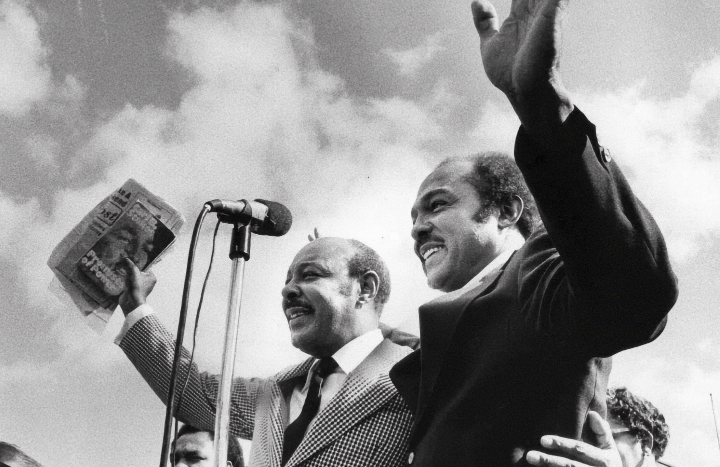
Stokes: Honoring the Past, Inspiring the Future
This collection of interviews was conducted by staff at Cuyahoga Community College's Jack, Joseph and Morton Mandel Humanities Center as part of a yearlong, community-wide commemoration of the 50th anniversary of Carl Stokes' election as mayor of Cleveland. Mayor Stokes and his brother, Congressman Louis Stokes, played key roles in the advancement of the city and the nation through the civil rights movement and beyond.