Hilton Murray interview, 21 June 2013
Abstract
Hilton Murray was born in Luverne, Alabama. Shortly after World War II his father decided that southern Alabama was too inhospitable for African Americans and joined the Second Great Migration, ultimately settling in Elyria, Ohio, to raise a family. After graduating from Elyria High School, Murray attended Kent State University and Cooper School of Art. After graduate school in advertising, he worked at WKYC TV-3 and WJW TV-8 in Cleveland. Much of the interview focuses on his difficulties as an African American man in a mostly white field. He also describes difficulties obtaining an apartment in Cleveland Heights as a result of his race.
Metadata
Interview Transcript
Transcripts may contain errors.
Hilton Murray [00:00:16] Good morning.
Katherine Taylor [00:00:18] Can you tell me where you were born?
Hilton Murray [00:00:20] I was born in a little town in Alabama called Luverne, Alabama. It is southeast of Montgomery, Alabama.
Katherine Taylor [00:00:33] Tell me about your childhood, please.
Hilton Murray [00:00:36] I grew up in Alabama, for about, what, maybe 4 years. My father was in World War II. Once he returned from the war, Probably within a year or so, he did not feel that he could raise his family in the little southern town in Alabama. At the time, racism was rampant. So he went north and visited Buffalo, New York. He went to Akron, Ohio. He came to Cleveland, Ohio. He came to Elyria. Then he also visited Lorain, Ohio. But for some reason, he kind of settled in Elyria, Ohio. He felt that that would be a better area to raise his family. By that, at the time, he had 3 children. My name is Hilton. I was the oldest, and my brother Wilson was next, and my sister Mabel was the youngest. So he moved his family. from Luverne, Alabama, to Elyria, Ohio. Pretty much grew up there, went to the Elyria public school system, Hamilton Elementary School, Franklin Junior High, and Elyria High School. At the time, from a educational, or now I'll just say more of a racial point of view. Most at the time, most of the African Americans lived in, we'll say, the south side of Elyria, and that's where we grew up. Again, you know, the— at the time, I think I got a pretty balanced education. By that meaning that I got a— the population of Elyria was probably, what, 85%, I would think, Caucasian or white, and maybe 15, 20% Black. So we weren't really a major threat in that situation, so we could go to school pretty easily. Racism did exist. At the time, I think our parents and our church tried to shelter us from as much of that as possible. Meaning by that, they tried to make sure that we didn't go into areas that weren't too confrontational or just racist.
Katherine Taylor [00:03:25] Do you recall any memories while in Alabama about racial confrontation, or even in Elyria? It's just you were aware of it, but you weren't really—
Hilton Murray [00:03:34] Well, I think the way it happened— I was too young, probably, when I was in Alabama, being that I left there probably when I was about 4. But I think it was— well, Blacks and whites did not live together. You were segregated. Blacks lived mainly with Blacks, and whites lived mainly with whites. Now, granted, Blacks usually worked for whites. They were the cooks, the maids, the laborers, the— all of that kind of stuff, but there was a definite separation of Blacks and whites in Alabama. Again, you must— let's see, probably around about that time, probably— I think probably the Klan probably still was active, but they weren't quite as active, meaning they were a lot more subdued. They weren't riding around in sheets, but people in the community knew who the good people were and who were the bad people.
Katherine Taylor [00:04:42] This was in Alabama?
Hilton Murray [00:04:44] This was Alabama, oh yeah, the South. The South is— that is the South. It hasn't changed really that much, I don't think. But let's see. I guess what happened, basically, was this, is that the adults tried their darndest to keep their kids out of harm's way. Meaning by that, you probably went to— being that it was a rural community, you would go to town maybe one day a week, because you were out in the country. So going to town on a Saturday to shop, to groceries, to intermingle with friends, it would probably be on a Saturday. Now, granted, now a lot of this I probably came back later on to find out and to experience, but it's not a— it wasn't a— I didn't have a lot of problems because I had family and friends that probably sheltered me from all of that. But once I— and again, even in Elyria wasn't really that bad, meaning by that there was a code, so to speak, that your parents kind of kept you in certain areas. They didn't want you to go to be harassed by either people, police, or whatever. But it's just subtle. It's like how— well, it's not very subtle anymore, is it? I was going to say it was more like, where's the North? The North, they wouldn't say anything, but there are situations that you just knew you weren't supposed to— you weren't welcome. There are ways of letting people know that you're not welcome. So now let's see. Now let's— we've talked about Elyria. Now let's go through an educational thing. That was— that's kind of important. Most— well, I can't say most. My parents placed a very high value on education. So they followed me all— My whole family, all through school. We had a two-parent family, a father and a mother. My father placed a very high value on education, so we had to toe the line on that. It was just unacceptable to get failing grades. That's another reason why I think a lot of— when my parents came north, they wanted things better for their kids. When we came to the area, I didn't have— But we didn't really— I didn't have very many problems as far as racial problems, except I think once when my— and maybe that would be elementary school. That would be Hamilton Elementary School. I had one problem there, and that was mainly my brother was behind me, we'll say, a couple grades. Some kid, some other kid was picking on him. And I confronted the kid and probably punched him out or something like that. So I was called to the office for that, whereupon I met with the principal, and he was saying, you know, he was reprimanding me for fighting or whatever it was. And I just told him, I said, you know, this person does not have the right to pick on my brother. If he picks on my brother, I will pick on him. So that was probably the first confrontation I had with some people just picking on my brother, you know. So from then, I was probably— I was pretty good in school, got good grades. I got good teachers. I got interested in the arts probably when I was in middle school. That's in Franklin. And I had teachers that were supportive, you know. They were supportive of me. They said, you know, you're a good artist, you know, etc., etc. So from middle school into high school, in high school I got more support. I drew well. I won competitions and things like that. So all of a sudden you're kind of, quote unquote, special. And so I kind of went into that area. They had competitions to paint scenes on windows in downtown stores. That's like Halloween, all those kinds of things. So I would do stuff like that. And then through my art class in high school, I ended up winning a contest— well, not a— an award to come to Cleveland to attend art school. It was Cooper School of Art at the time, down on Euclid, about 17th, I think, and Euclid. So that again kind of pushed me in that kind of artistic direction. And Eventually, I got out of high school. I also played sports— basketball, football, basketball. I lettered in all 3 sports, probably throughout my high school career. At that point, I started— when I became a senior, I started looking for schools to go to as far as art. And I wanted to go to—
Hilton Murray [00:09:50] New York, there were a couple schools there, one called Pratt Institute and Parsons School of Design. Those were the premier art schools, you know, at the time that I did my research on. And that was, that was pretty exciting to think about that. But after researching them for a while, my mom basically said that, you know, at the time, it was probably in the— what, had to be about '56 or so. 1956. That's when I started high school. I got out of high school in 1960. At the time, being from a small town in Alabama and hearing of all the stories about New York City and how fast and corrupt and all these— there's just no way she's going to let her son go to New York. So she said, I can go to Pick another school. I ended up going to Kent State University. She said, go to Kent. You can go there for a couple years. Once you mature a little bit more, get a little older, then maybe you can go to— transfer to New York to go to one of those schools. But the way it usually happens, as you know, is that once you go to school, you develop relationships and friendships. 2 years after being in Kent for a couple years, You didn't want to transfer because you developed these relationships.
Katherine Taylor [00:11:11] While you were at Kent, were you involved in anything in Kent? There was an incident in Kent.
Hilton Murray [00:11:17] I missed that incident. I was out before that incident happened. But we did boycott some things at school. We did marches and all of that stuff. We did it because they had problems then. Kent had problems. Tell me about that. Well, basically, it's like everyplace else. Everybody don't like Black folks. Kent was no different. What they'd do is that they would have ways of getting rid of Black folks. You would go to certain classes where the professor would tell you that he basically didn't want you in his class, and if you If the best you can get out of my class is maybe a C. But basically saying he didn't want you in his class. We had little protests concerning that, but also once you get there, Black folks have a tendency of trying to help other Black folks, so you're kind of nurtured. You brought in and said, well, this teacher is a racist. You can't pass this class. You will not pass this class. No black yet has passed this class, so why subject yourself to that particular professor? Go to another professor who is a little bit more even-balanced, a little nicer. This is a slight digression. In retrospect, even in high school, you found the tentacles of racism. For instance, Here's an example. I played football. On the football team, from my perspective that is, the best players on the team, whether it was offense or defense, were usually African Americans. Usually. And so when the Black players got together, you get outstanding offensive players, back and Line, and the same thing, defense, back in line. And the way we figured it was that of those 4 awards, we should get 3 of possibly the 4. Maybe the one we didn't get maybe might be the quarterback, because we had guys who were like All-State running backs and this and that, and defensive All-Buckeye Conference and so forth and so on. So what happened, this was Strategic. This is how it usually works. It's the game, right? It's the game. How is the game played? So what they ended up doing was this. They took— I just— it's still— it's good. What happened was, this was kind of interesting, and I thought they took the 40— the four areas. They took the— our best running back, who was probably, what, all-state almost, you know, the best. They took him from offense Moved him over to defense. And they took a couple of— they just flipped it. Where there should have been three African Americans and one white, they made it three white and one African American because they totally— Moved the game, changed the game. The best offensive and defensive player weren't— they weren't that, nor was the offensive back— was not that. So they could— so it's how the game is played. That was the first exposure that I had of how perception, how, how the system kind of works in a very abstract, abstract manner.
Katherine Taylor [00:14:49] Was that at Cooper?
Hilton Murray [00:14:51] Oh no, no, no, no, that's high school. It's back to Illyria High School.
Katherine Taylor [00:14:54] Okay.
Hilton Murray [00:14:55] High school.
Katherine Taylor [00:14:56] Okay.
Hilton Murray [00:14:56] Illyria High School. So that's when I kind of got an inkling that perception is not always what it's supposed to be. In going to Kent, again, we had small groups. We had boycotts. We knew what teachers that were pro, that would accept us, and those who wouldn't. I was involved in a fraternity at Kent State University. It was Kappa Alpha Psi fraternity. We were known at the time as a social fraternity, which we were, but one of my charges was to take that and make sure that our members, whether they're members or whatever, placed emphasis on academics. We would say things like, your parents sent you here to get an education. You're using their money. To come here and just party is a waste of your time and your parents' time. And it's a disappointment. And furthermore, we, our fraternity, want to be the top academic fraternity on Kent's campus, and we've achieved that a few times. So again, saying it's great to have a social fraternity, but the goal from my perspective, or our perspective, was that you're there for an education. And that was one of my main charges at Kent, is to try to make sure that To save as many of our brothers and sisters as possible, which is not easy.
Katherine Taylor [00:16:30] Were you ever in the military?
Hilton Murray [00:16:32] No. At the time I was in school was when 'Nam was going big. You bring up an interesting point. When I was getting out of undergrad school, I had a fantastic advisor, a guy who I really admired. His name was Robert Short. He was in advertising and marketing. That was his background. There was about 12, we'll say, of the so-called elite art advertising marketing students, and we were in his class. That was the crème de la crème. In that group, there were 12 of us. Of the 12, there was only two African Americans, me and my roommate and friend that I developed down at Kent. Another thing that's interesting about that is that now here we are in competition with these other 12, ongoing. All projects are very competitive. Me and my guy, we want to be the best of those 12. We want to be the— that was our charge. We were going to just show them, show our props, show that we're the best of the best. Okay. So we handed in our final projects. The professor, he just kind of said, okay, you guys know that you finished everything. You've all got good grades, et cetera, et cetera, et cetera. Then he asked the other question. He said, what do you guys plan on doing now that this is your last class?[00:18:06] You're graduating and all that. Now, what are you guys going to do after you get out of here? He kind of went around the room. What I found, another one of these things that I found not shocking but eye-opening, is that almost every one of those kids in that class, all those 12 of us, 12, 10 whites, almost every one of those kids in that class had jobs. Their father, their uncle, There's somebody, etc., etc., etc., had jobs. The only people who didn't have jobs was me and my friend. Now, that's not their problem. It's just that they were connected. Also, the field that I went into, this advertising and marketing thing, is a predominantly white area. When I went to school, and before I went to college, and I was talking to my father about that, he said, what are you going to do when you go to college? You know, he said— I said, well, I want to go into, you know, advertising and marketing, something like that. And, uh, you know, I'm getting out of high school now, and he kind of looked at me. He said, what do you want to get into again? I said, just advertising, you know. He said, oh, okay. So he goes away, and about two weeks later he comes back and he says, Hilton, you know, I checked around a little bit about this advertising marketing thing. And he said, ain't no Black folks in advertising and marketing, Hilton. And I said— he said, now did you understand what I'm saying? There ain't no Black folks in advertising and marketing. Me being the idealist Well, Dad, there has to be a first. I'll just be one of the first. Just not realizing that what he was basically trying to tell me, that you're going into a predominantly white field, that you're not going to get all the kind of support that you think you should get. You won't be getting any of that. It's going to be lonely. It's going to be hard, and it's going to be racist. Now, he told me that in his own way. Then he said, well, if that's what you want to do, I'll help you. I'll give you all the help that I can. During that time, he would usually— at our time, when we went to Kent, there were quarters, not semesters. There would be three quarters versus two semesters. He said, okay, let's go for it. He was able to pay— I was able to— In the beginning, he would pay for 2 quarters, and I would pay for one quarter. That's how I got through school, working summers, worked construction, worked down in holes, worked in security, any way to make some money. In the middle of the wintertime, security guards, just anything to make a little money to help defray my educational expenses. In saying that, it was always there, see. People would always tell you, but they wouldn't tell you the worst. They wouldn't say, you can't do this, or, don't go into that field because it's just— there's not very many people in that field. There's a reason why people aren't in that field. Once they try, they get beat up or pushed out or whatever. He tried to tell me that, but I just didn't buy it.
Katherine Taylor [00:21:45] Tell me about marriage and children and moving in Cleveland Heights.
Hilton Murray [00:21:49] Okay. Good. In grad school— that's another thing. The guy that was my advisor in undergrad After that class I just mentioned to you, where we didn't have any jobs, and he basically came up to me one day and said, what are you doing after you get out of comp? What are you going to be doing?[00:22:16] I said, probably going to 'Nam. That was the thing at the time. Either you're in school, or after that, you go to 'Nam. He said, well, I don't think that's a very good idea. He said, so I'm starting a graduate program. It's gonna be a two-year graduate program. You get a Master of Fine Arts degree, that's MFA. And he says, what I'm doing is I want to— he says, there are not a lot of, um, of, uh, creative directors in the area of advertising and marketing. He said, there are people, photographers who become creative directors, there are people who are artists become creative directors. He said, but there's no people that are trained in television, photography, film, radio, and print. And he said, what I'm going to do, I'm going to start a program that will teach, you know, you to be a creative director, and you'll be able to, you know, do great things in the area of advertising and marketing. So to me, it was a no-brainer, right? I got a choice of either going to grad school or going to 'Nam, so I chose to go to grad school. In going to grad school, I did study those respective disciplines. Also in grad school, I met my wife-to-be. She was, I think, just about graduating, and I was in grad school. We met, and then I left grad school. And then I moved to Oberlin because I lived in Elyria. I couldn't go back to Elyria. Elyria is too— I have too much family in Elyria, if you follow my drift. So Oberlin was much more to my liking. It's a college town. I'm used to that. I'm coming and going as I please. I lucked out and got a job in Cleveland at Channel 3 as a graphic designer. I'll send you a— a resume with all that stuff on it with specifics. I met my wife in my last year in grad school. We developed a relationship then. Then I moved to Oberlin, and then we kind of connected at Oberlin and hooked up there for a while. We dated for a while, and then I left Oberlin. I think I worked in Oberlin with Maeve for about two years. About a year. Then I left the country. I ended up— a friend of mine was working at the American Embassy in Tokyo, Japan, and he invited me over to visit with him. I was planning on moving to Japan. But I went over there, and my father had a major back operation, which brought me back to Oberlin. Wife hooked up eventually. A date, a specific date system. I think it was like about '73 or something we got married. Can't work with that. I don't think. So we got married about then. Well, we can still talk the best we can. So we got married. Eventually, as far as moving into the Heights, I was in Oakland, so I was commuting for about maybe 9 months or so. Then I decided to move closer to my place of employment. Okay, so I ended up— at the time, you would go to movies in the area, and they would show Cleveland Heights as the Mecca. Meaning by that, we believe in inclusion, we believe in this, we believe in that. It's like they beat the drum, you know, that's what they did. And so eventually I came to Cleveland Heights. Euclid Heights Boulevard was, you know, I had friends here and I ended up going up and down Euclid Heights Boulevard, trying, you know, knocking on doors. Total rejection, not accepting it. You'd call over the phone, you sound okay over the phone.
Katherine Taylor [00:26:35] So they were steering?
Hilton Murray [00:26:36] Oh, that was a given. It's a given, yeah. They were steering. Actually, I don't understand how— yes, I do understand how. I just lucked out and got a place where the people for some reason At that moment, didn't see it as a major problem. But see, that was not the general consensus of Cleveland Heights. So I was lucky enough to get a place on Euclid Heights Boulevard. My father, you know, we were trying to— it was a nice, it's a big place, but it's a big old place. My father came over and he was trying to help me get together, so he ended up keeping all of— some of friends and we painted some of these places. It was not bad, but it was— the heating wasn't good, you know what I'm saying? The area was okay. We tried to do our best we could for it, but it just— Cleveland Heights was not a mecca, you know. It was very racist. So that place was okay. Then once my girlfriend moved up, I had to get someplace a little bit better, so I ended up going down the street, top of Cedar Hill. Top of— is that Cedar Hill, that apartment building right there next to Nighttown? You go up, when you go down Euclid, that one on the corner right there. I was lucky enough somehow the people who were there were just decent, I guess. And what's strange about it, they were, I think they were rural people, the managers of the building. They didn't seem to have a problem with me coming there, which was kind of different. Maybe that's the reason why they let me in, because they weren't from Cleveland Heights. You know what I'm saying? They weren't caught up in whatever that was. We ended up living in that apartment for about 5, 6, maybe 6 years or so, and then we decided that we wanted to have a family. How old were you? Then we moved from there over to where we are now, which is Clarendon, right over the street here. Once we got in there, we said, okay, now we've been together. If we're going to have children, we should just go ahead and try to start a family. We were lucky enough that within a year or so, we ended up having a child, and that's our son, Michael. Since we started a little bit late, It wasn't like we were going to have 5 or 10 kids. Furthermore, I wouldn't want that many anyway. So somehow it came out that I told her that I think I'd like to have a namesake, someone to carry on the family name, preferably a son if possible. If not, so be it. So we lucked out and had a son. And so she— I'm paraphrasing here now— she said, you got your son, now that's it. So we've been lucky. We have a great son who is the pride of our eye. He's done— he went to the College of Wooster. He got a degree there. He graduated with honors. Let me take this. Hello, may I help you?
Katherine Taylor [00:29:46] We shut down for a moment. Now we're returning back to Mr. Murray. Continue.
Hilton Murray [00:29:53] Okay. We left with my family, right? Yeah, we have Michael. Mike is the apple of our eye. He's a really, really great kid. He went to the College of Wooster and graduated from there with honors. Came— left there, started his own business in Cleveland Heights. He, after starting his own business, he also went back to grad school, went to Cleveland State, whereupon he got his master's degree in counseling. So from our perspective, he's, you know, he's got the foundation to do, hopefully to do well. So He had a business for a while, for several years. He had a landscape business. While he was going to the College of Wooster, in the summer he worked as a landscaper with one of the local landscape people. After graduating from the College of Wooster, he started his own landscape business, which he's done quite well with that. After doing that for a while, then going to school and all these other things that he's been doing. He decided that he wanted to sell his business, which he has. He got his degree from the college, from Cleveland State University, and now he's a counselor at Rocks Middle School, Roxbury Middle School here in Cleveland Heights. He's doing quite well there. Another thing, again, talking about him, is that one of the things we kind of liked about the Heights is again its educational system. My wife was a Kent alum as well, but she also came to Cleveland Heights and basically followed our son through school, meaning by that she would volunteer in the elementary schools and eventually once he got to maybe middle school She ended up going back to Kent, getting a master's degree in library science.[00:32:02] So she's been— so eventually she worked at Fairfax, Roxboro Middle School. Eventually she got a job at the Cleveland Heights High School library, and she retired from there about 4 years ago. From our standpoint, the Heights, in spite of its so-called problems and things, we didn't concentrate on a lot of that. We just tried to do the best we can with what we had to do.
Katherine Taylor [00:32:40] Did you work from the multi-listing? I understand that at that time there existed a multi-listing.
Hilton Murray [00:32:46] No, I missed that, I guess. I missed the multi-listing part.
Katherine Taylor [00:32:50] Yeah, I understand. I've heard about multi-listing.
Hilton Murray [00:32:54] Yeah, right.
Katherine Taylor [00:32:55] Blockbusting and all of that stuff.
Hilton Murray [00:32:57] Well, what's going to be interesting to you is this. I am going to refer you to a good friend of mine, and his name is Lou Burroughs. I'll get you the appropriate name and phone number. He was, now from that point that you just touched upon, he was instrumental in busting the Cleveland Heights housing situation. He was very instrumental in doing that, whereupon he literally took Cleveland Heights to the— The Supreme Court. to the courts and sued them. He will have volumes of stuff about how the Heights tried to keep— he's an African American real estate person— how they would not allow African Americans to even sell homes in Cleveland.
Katherine Taylor [00:34:03] That's interesting.
Hilton Murray [00:34:05] Heights, and how he took them to court. They wouldn't allow him to advertise on radio or TV, any of these kinds of things. I think you will have a wealth of knowledge from him concerning these kinds of— as you talked about, as far as the racial— makeup or how they tried to keep African Americans out of Cleveland Heights, even though they were saying that they wanted them to come to Cleveland Heights.
Katherine Taylor [00:34:46] Tell me about your real estate— I mean, not your real estate, but I understand you have your own business. Tell me about that.
Hilton Murray [00:34:52] Right. Okay. Well, my background is something like this, a little quick synopsis. Went to school and majored in advertising, art as it applies to television. So my background— so I studied television when I was in school, advertising, art, art history, as well as, you know, the how-to-do business. My first job was here at TV 3. I got a job there as a graphic designer. I was there for about 9 months. After being there for 9 months, I got a call from Channel 8. They were looking for an art director, so I told my art director, who was a good friend of mine from TV 3, I said, I don't want to go interview with those folks, because they basically— TV 3 had promised me that I could go to NBC New York after about a year. That was what I wanted to do. I wanted to go to New York, because that's where the happenings were. So I talked to my guy, and I was saying things. I said, well, I got a call from Channel 8 up the street, and they're talking about they're looking for an art director, but I've been here for 9 months. You said I could possibly go to New York within a year. I want to go to New York. He said, well, he said, why don't you go listen? Go talk to them. So I called the guy back and I said, you know, really, I'm not really interested in a job over there. He said, listen, why don't you come over and talk? Talk won't cost you a thing. Take a little bit of your time. So I go over there and the guy is saying things like, well, we know, you know, somehow you come highly recommended. And I listened to this guy and I said, I've only been working for 9 months. How do you know what I can do? He said, well, we've checked and you come highly recommended. If you come with us, we'll give you these kind of monies. You run your own department. You can hire and fire, etc., etc., etc. I said, well, I'll take it under consideration. I go back to my TV 3 art director buddy. I said, Bob, they're offering me this, this, this, this, and this. He says, Hilton, I can't offer you that kind of money. I can't do that for you. What I would suggest you do is, why not take it? You would have to work a long time to get that kind of money over here. I said, okay, then I'll take your advice. I went over and took the job. Again, over there, as the art director of TV 8, again, you being a person of color, First of all, they don't think— they didn't think you knew your job. That's one. Two, I knew my job. I knew my job exceptionally well. I was probably overtrained for the job, but I loved it because it's what I do. I'm a problem solver. You do set designs for news shows, and you do print, you do radio, you do TV. And, you know, I'm just rocking and rolling. That's what I was trained to do. So it was a no-brainer for me, right? So, but I'd had a lot of problems with the crew, people that was, you know, I would design sets and they were supposed to build them, you know. And so I'd go in and tell them what I want. I give them schematics and all this stuff. And, you know, they're, uh, I don't want, you know, basically, I don't want to work for you because you're Black. And so, uh, I You know, at the time, I was a little militant. I had my Afro jumping out here someplace, you know, and I just didn't take too much stuff. So I'd go. I'd say, hey, you can do it the easy way, you can do it the hard way. You know, we can fight. I don't care. But this is what I want, you know. And so eventually, they kind of bought into it. I was lucky enough to be really good at what I did, and I ended up— I ended up getting a lot of attention, a lot of write-ups, a lot of awards. I'd get national awards, international awards for my—
Katherine Taylor [00:38:57] Tell me about those awards.
Hilton Murray [00:39:00] Usually, you work in conjunction with the promotion department, right? You do newspaper ads, print ads, brochures, booklets, etc., etc., etc. You do all kinds of stuff, print stuff. I would do it. And I did it really, really well, and so it's a kind of a catch-22. I do it really well, and even though I have a staff, some things I just do, and then sometimes they get jealous. Meaning by that, my supervisor, which could be a promotion manager, production manager, they would just get, you know, jealous. And they'll say things like, well, why don't you let your— you know, you've got all these awards for your work. Why don't you let the people that work for you do some of those awards? I said, there's no problem. So I give it to them, my people, my own people, my own staff, right? I said, but, and then, but they didn't have the, the look, you know. You, you have it, you know. That's what I went to school for, to have it, you know, to have that. It looked— you make it look easy, but that's years and years of doing it. The, you know, study. So then all of a sudden I said, you know, I do it this way, I get awards. I let my people do it, maybe they don't get the awards that I get. And so this goes for a while and a while. I end up joining some national organizations in television, some boards and things. And then you go to these boards, it's the same thing. Who's in the boards? 90% of the folks are white. looked up and found another brother out of D.C. So we hooked up, meaning only two of our kind, so we had made a relationship. In doing this, again, you do well, and I'm meeting people, network people, people that I— TV personalities. You just meet them because of the circles that you're running in television. Then we go to these conferences and things, and then I'd bring my supervisor, the person that's over me, I'd bring him in and say, oh, by the way, here's so-and-so. He's cool, blah, blah, blah. He's working on this network show or that show. Sometimes, I'd have to come out, I'd get this look like, basically, how do you know these folks? They shouldn't be talking to you. They should be talking to me. That goes on for a while. Hold on. Hello, may I help you? Still good. We're just right up to it. Okay, what was I saying next?
Katherine Taylor [00:41:33] We're returning back to the recorder again. This is interview with Mr. Murray.
Hilton Murray [00:41:39] Right, so yes, so what would happen is that it was always this, this duality of doing stuff, you know, and so eventually I'd go on some of these— I went to a meeting, a national conference in Nashville, Tennessee. I developed a rapport with a PhD out of New York. We were sitting at a table and we were talking. I was telling him I was having these problems with my— I said, I don't understand it. I do— I let my people do work, and then they say that I am letting my people do too much work. Then I do some of the work and they say that, you know, that you are doing too much of the work. So the idea was that whatever I did, there was always some concern about it. I either— I won awards, they don't like that. I let my people work and they say I work my people too hard. So I was talking to this Dr. Finkelman friend out of New York and I was I'm sharing my concerns with him. I'm saying, what's going on? He's a PhD in psych and all that stuff. He said, Hilton, Hilton, Hilton. I said, there's no basis. He said, you just don't get it, do you? I said, what do you mean I don't get it? He said, no. He said, look at this, Hilton. He was, I guess, bright along the way. He says, look at you. I said, okay, I'm looking at me. He said, you're an African American male. They've been told all their lives that you can't think, you can't do, you're limited. Okay, that's one. He said, you're articulate. You got Probably more degrees than they have. You're winning awards. You've got people that you know all over the country think highly of you. Some of them have tried to recruit you to their respective stations. You've gotten requests from New York, Chicago, San Francisco, LA, Seattle. You developed this network of people who like you and what you do, and they're willing to hire you. And they basically can't believe, why are you in Cleveland? Why are you in Cleveland? It's backwater, it's country, it's racist, and you're in Cleveland. Then he said, now, you put that on one hand and you see the people that you're working for, and basically what he said, you just don't fit. He said, so as long as you work in a market like this, Cleveland, there's going to be somebody over you who is going to mess with you. I said, no, it's not the idea that it's about you. I said, TV caters to a certain kind of person. They're not the brightest. They're not the best. They're not— they don't seem— most of them got their jobs because of who they know, not what they do. So they get these people in these positions, you're really— so they can't deal with you. And they said, so you have a choice, Hilton. You either can— if you stay in that situation, it's going to be the same. If you— or else you go out of that situation and do your own thing. And I said— so I said, oh, okay. And then he said, and you, Hilton, he said, you can't change them. They are what they are, and you are what you are. You can't dummy yourself down to that, nor can they raise themselves up to be open and constructive people. He said, it's just that simple. You have a choice. Put up with the bull or leave. He says, it's just that simple. It's no big thing. And he said— I said, oh, yes. He simplified all of this, what I was trying to do on my own. That's another thing, too. It is sometimes very, very lonely being an African American male in a predominantly white society. It's just, you know, because you're told that you can do it. You're told that you can do it by yourself, but in reality, you cannot. When you see— okay, for instance, in television, I also tried to get into the agencies. No agencies would accept an African American male when I got out of grad school. I went all through Cleveland trying to get into advertising agencies. Over the phone, I sounded great. When I talked to them over the phone saying, oh, yeah, your resume looks good. Why don't you come on up and see me? So I'd come up and walk through that door and you see the look. Like, I didn't know that you were Black. Or I even had people talk to them when I was in Kenton, by the time I drove to Cleveland, the job that you were coming to apply for was just filled. Why would you admit that? That's a— it wasn't true. So that's an ongoing thing. In saying that, I look at how our society is treating our president. It's unprecedented. How they treat him is how they would like to treat us. I don't care where you are, it is there. Racism is running rampant in America, and it's sad. It's sad, you know, that probably the most brilliant president we've ever had has to waste his time dealing with racism at its basic form. So my thought is always— my thought now is this, is that You got to— the best you can do is what you can do, but you can't— what I hate about this country right now is this, is that they're catering to the lowest of the low. When you have your so-called representatives, senators, congressmen are bottom feeders. They're not addressing anything. To help this country. How can you let people starve, no education? We don't take care of our troops. We don't take care of the poor. We don't take care of the hungry. But Wall Street gets a pass. They bankrupt the whole country, and then Main Street bails them out. And now they don't even— now, as far as they're concerned, Main Street doesn't even exist. It's a sad state of affairs, when the country is literally taking itself out.
Katherine Taylor [00:48:58] You have so much to offer in this interview. You mentioned national boards. What national boards were you on?
Hilton Murray [00:49:03] Oh, I'll send you all that stuff in the form of my résumé with all that stuff.
Katherine Taylor [00:49:10] Is there anything else you want to talk about that you think is important? I think it's exciting for me to know it because I know you indicated that you wanted to be pressed for time.
Hilton Murray [00:49:20] A little bit pressed for time, agreed. What we can do at some point, if you— after I send you my resume and all that stuff, which have more details and boards and time—
Katherine Taylor [00:49:30] We can set up another interview?
Hilton Murray [00:49:33] If you think it.
Katherine Taylor [00:49:34] I'd love to do that.
Hilton Murray [00:49:35] But I think what you're going to really be blown away, is with my friend, Who was more, for lack of a better term, on the ground with Cleveland Heights and how it treated African Americans trying to move into the community, and how he literally had to take them to court, sue Cleveland Heights. That's going to be invaluable to you. And he's quite a talker, so for him, you might have to allow about 2 hours.
Katherine Taylor [00:50:08] Sounds good. What about your— you didn't mention your company.
Hilton Murray [00:50:11] What's the name of your company? It's HPM Consultants. We're an advertising marketing firm. We've been— well, I've been in this business for over 30 years. We've been lucky to work with some big, important companies. We've worked with the lottery. We've worked with Cleveland Clinic, Huron Hospital, and a number of others that will also be on my resume for you.
Katherine Taylor [00:50:38] Okay.
Hilton Murray [00:50:38] I'll send you— you don't have a card?
Katherine Taylor [00:50:40] No, no, I don't have a card.
Hilton Murray [00:50:43] Okay, so what we'll do is this is why don't you give me— write down what you can, and then I in turn will send you a packet of information that will be helpful to you.
Katherine Taylor [00:50:54] We are gonna conclude this first interview with Mr. Murray. Thank you very much.
Hilton Murray [00:50:59] My pleasure, my pleasure.
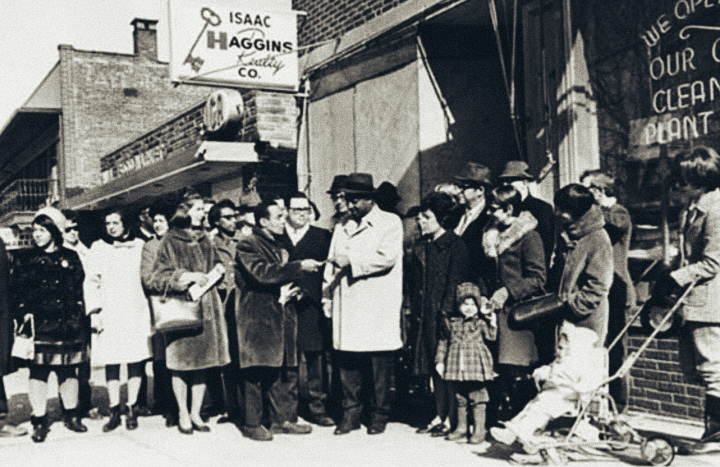
Racial Integration in the Heights
Interviews in this series were collected by undergraduate students at Cleveland State University under the supervision of Dr. Mark Souther, with funding from the Office of the Provost. The series contains interviews with pioneers of suburban residential integration and social activists who supported peaceful managed integration/desegregation and fair housing in Cleveland Heights and Shaker Heights in the 1950s to 1970s.